Cost-Effective Prototyping with Consistent Dimensional Accuracy
Precise PLA is an engineering-grade polymer filament designed for controlled, repeatable prototyping. It provides stable print behavior, allowing engineers to validate geometry, fit features, and assembly clearances before transitioning to production materials. In addition, the affordable prototyping filament reduces development cost while maintaining the necessary for early-stage verification.
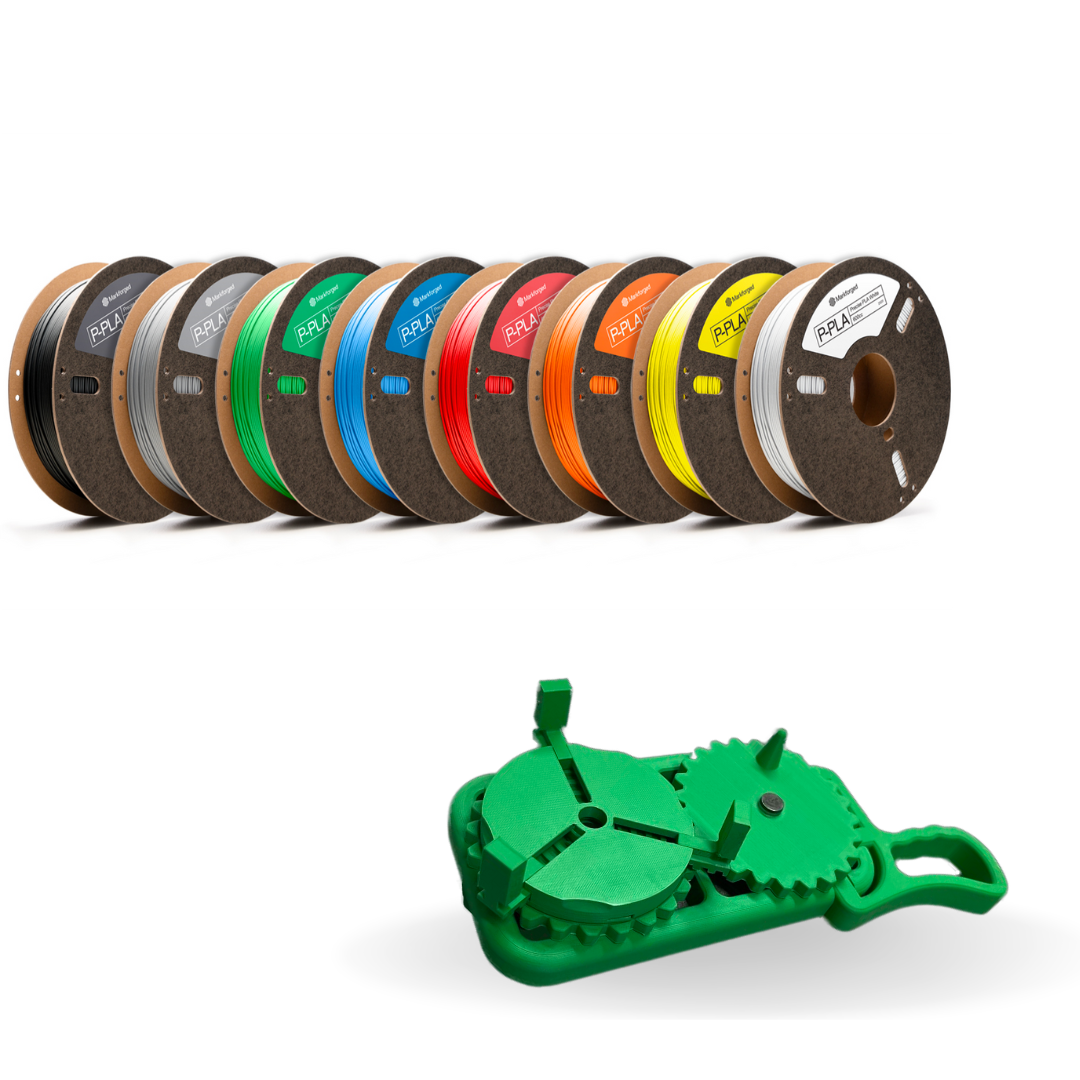
Its also formulated to minimize warping precision and dimensional drift to support reliable build accuracy for detailed test components. Its smooth surface finish enables precise feature inspection, while multiple color options simplify part identification during design reviews, ensuring Precise PLA remains an efficient material for fast, engineering-driven prototyping.
Integrated Workflow for Engineering Teams
The filament operates across Markforged platforms including the Mark Two™, Onyx Pro™, and Industrial Series systems equipped with the A3648 extruder. Because it integrates directly with Eiger™, engineers can use the same software environment applied to composite and CFR workflows. This maintains process continuity between prototype evaluation and functional-part production. While Precise PLA is optimized for prototype 3D printing, it is not intended for structural loads or CFR reinforcement. Instead, it serves as a controlled, model-grade polymer filament for geometry confirmation prior to printing Onyx® or reinforced composite components.
Optimized for Manufacturing Development Cycles
Engineering teams use Precise PLA as a detailed 3D print material for rapid iteration in environments where speed, accuracy, and repeatability directly influence development timelines. Its predictable print characteristics reduce the risk of rework and support parallel testing of multiple design variants. In addition, the cost efficiency of the filament enables extensive design exploration without impacting budget or production capacity. This makes it a practical tool for manufacturing engineers working through early-stage validation before committing to reinforced or production-grade materials.