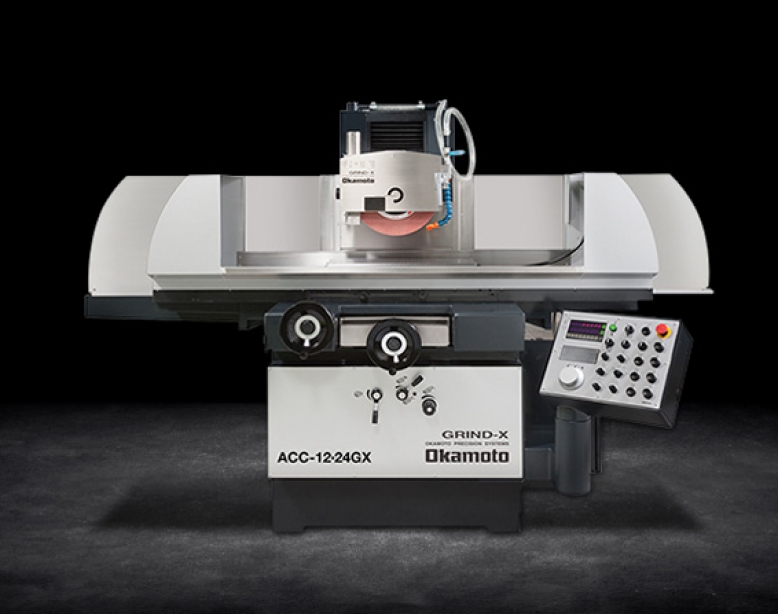
The Okamoto ACC-GX Series machines are one of the most used grinders in existence. They are known for easy operation and consistently deliver unmatched performance, accuracy, and reliability, setting them apart as leaders in their class. Loaded with numerous standard features, the ACC-GX Series Grinders establish themselves as the value leader in Okamoto automatic surface grinders. Operating this machine is a seamless experience, making it a must-have for machine shops.
Features
| Max Cross Travel | 13.3" |
|---|---|
| Max Table Travel | 29.5" |
Choose the Okamoto ACC-GX Series for a saddle grinder that exceeds expectations, and provides the precision and efficiency essential for machining environments. Designed with cutting-edge features to redefine automatic surface grinding standards. This machine features a state-of-the-art control system and user-friendly interface. As a result, engineers will experience effortless operation and integration into any workflow with precise requirements. In addition, the robust design and superior construction make it durable and reliable to ensure consistent performance in demanding applications. Choosing the Okamoto ACC-GX Series means investing in a grinder that meets the dynamic needs of modern machine shops and embraces the future of automatic control technologies for enhanced efficiency and surface quality.
Compare with other Okamoto Saddle Grinders for sale
| Max Cross Travel | 13.3" |
|---|---|
| Max Table Travel | 29.5" |
ACC-GX Series
6 Sizes available
8″ x 20″ to 20″ x 40″
The Okamoto ACC-GX Series is an automatic saddle-type surface grinding family positioned for shops that want repeatable production cycles while retaining a conventional surface-grinding workflow. A.W. Miller Technical Sales supports manufacturers throughout New York, Pennsylvania, Maryland, Delaware, Southern New Jersey, and Quebec with applications engineering, installation, training, and service support.
Within Okamoto’s form and profile lineup, the GX Series sits between basic manual grinding and the more programmable SA1 and 818SAiQ platforms. Application selection should therefore focus on part size, recurring flatwork, required automation, dressing strategy, and whether the geometry actually requires CNC form capability.
Applications commonly evaluated for the ACC-GX Series include:
Recurring rough, finish, and spark-out sequences can reduce manual intervention on repeat surface-grinding work.
The architecture keeps the work zone familiar for setup, indicating, wheel changes, and magnetic chuck work.
Automatic cycles help standardize the sequence between operators and across recurring jobs.
The GX Series targets applications that need automation but do not necessarily justify CNC contour or form programming.
Okamoto lists the GX Series as an automatic-control platform, above manual grinding and below MDI/CNC models in terms of programming complexity.
Recurring flat surface-grinding jobs are the natural fit, especially where automatic cycling improves consistency but the part does not require complex CNC-generated forms.
The decision should compare the required level of programmability, crossfeed control, dressing automation, job mix, setup frequency, and whether MDI functions will materially improve the process.
No. Wheel specification, dressing interval, coolant, workholding, stock distribution, feed, infeed, and spark-out still determine grinding performance and part quality.
Representative drawings, material, workpiece dimensions, stock allowance, flatness and finish targets, current cycle information, wheel preferences, and expected production quantities are useful starting points.