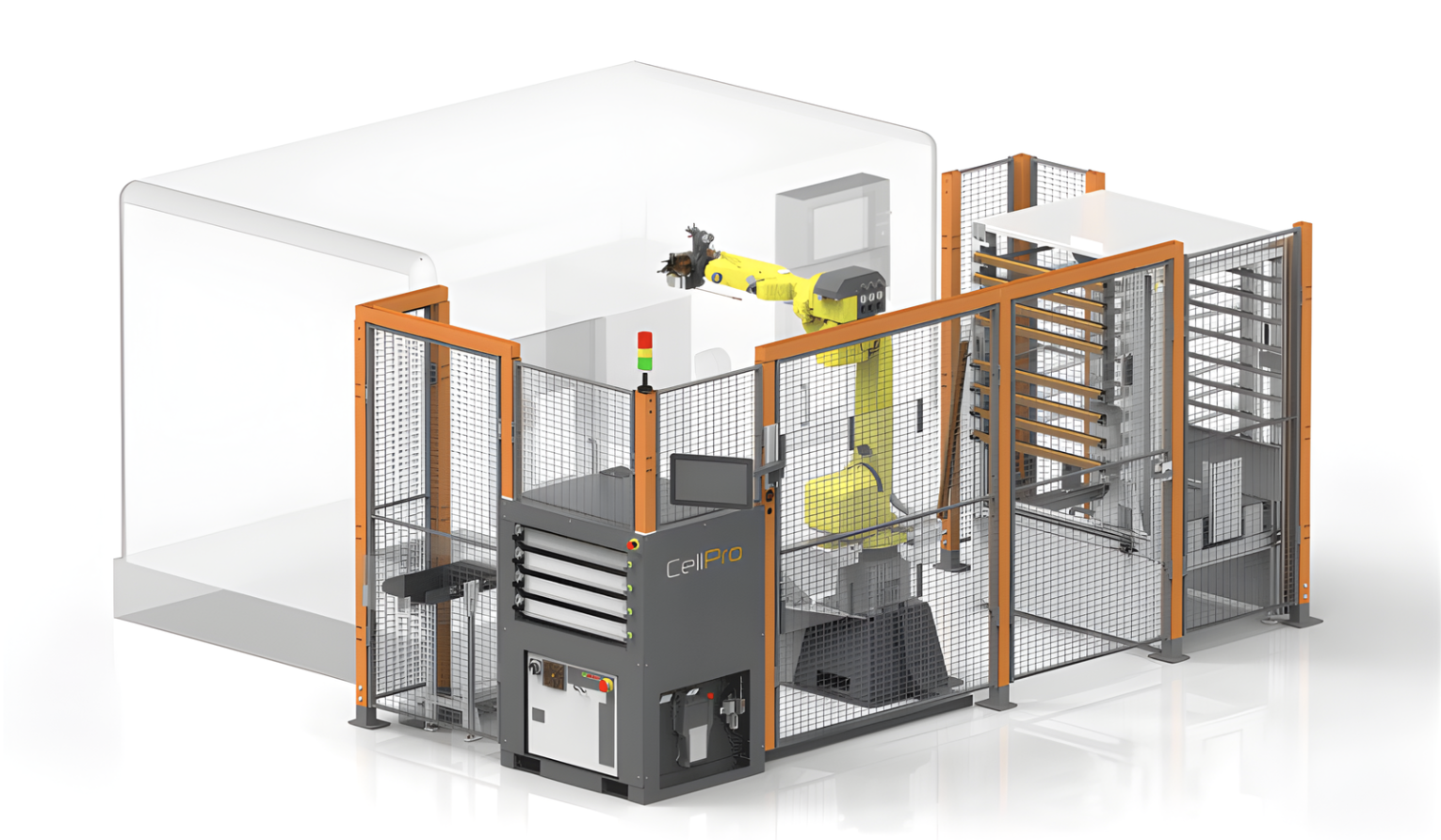
The Agile Modular CNC Machine Tool Loading System is designed to simplify automation across multiple machines. Built for flexibility, it supports Multiple CNC milling machines loading and adapts easily to changing part runs. This robotic CNC machine system reduces labor demands, improves cycle consistency, and provides scalable CNC automation solutions for modern production environments.
Agile Modular CNC Machine Tool Loading System Features:
The Agile Modular CNC Machine Tool Loading System is engineered for flexibility. It integrates a single robotic system with CNC machines to load and unload multiple mills, lathes, or hybrid setups. In addition, each cell uses pre-engineered modules and part staging drawers for fast changeovers and safe material flow. The system’s modular design keeps cycle times consistent and throughput optimized without redesigning existing machine layouts.
Powered by the Agile Cell Controller, the system manages motion paths and machine interfaces through one unified platform. In addition, the software synchronizes communication between robots and machines to minimize downtime and maintain continuous operation. By standardizing control across every station, the Agile Modular CNC Machine Tool Loading System simplifies complex workflows, enhances repeatability, and strengthens overall CNC automation solution performance.
The Agile system allows manufacturers to add additional robots or machines as production demands expand. In addition, the cell’s compact footprint, safety enclosures, and automatic calibration features make it a durable solution for high-mix manufacturing. For CNC engineers focused on efficiency and reliability, this modular platform simplifies integration and maximizes machine utilization.
The Agile Modular CNC Machine Tool Loading Systems is an pre-engineered, configurable robotic machine-tending platform. It is configured to move raw and completed workpieces between organized storage and the CNC machine while machinists remain available for setup, process control, inspection, and other skilled work. A.W. Miller Technical Sales supplies and supports Agile robotic machine-loading systems throughout New York, Pennsylvania, Maryland, Delaware, Southern New Jersey, and Quebec, with application review, cell integration, installation, training, and regional service.
Agile Modular combines AgileGO! control software with selectable robot, pallet, drawer, conveyor, cart, track, vision, re-grip, and peripheral modules. Published examples include multi-product tending, two-machine conveyor cells, robots serving three mills, and heavy parts weighing up to 350 lbs. Final system capacity must be confirmed with the complete part, gripper, robot reach, storage arrangement, machine interface, safety layout, cycle-time target, and unattended production plan.
Applications commonly evaluated for the Agile Modular CNC Machine Tool Loading Systems include:
Standardized modules can be combined around the machine layout and production objective without forcing the application into a single fixed footprint. This supports more flexibility than an Agile Flex cell while limiting unnecessary custom engineering.
Drawers, pallets, conveyors, tubes, and dockable carts can supply different part families or operation stages. The cell can be planned for current output and expanded as machine count or process scope changes.
A robot can tend more than one CNC machine when reach, cycle balance, guarding, and machine availability support it. The correct comparison is cell throughput and robot utilization, not the number of machines alone.
Operators configure defined process parameters instead of building every robot move through conventional point teaching. This simplifies changeover and troubleshooting while preserving the engineered motion and safety limits of the cell.
The main differences are robot class, part size and weight range, and whether parts are staged on pallets, in drawers, in zero-point vises, or in shaft nests. The correct model follows the workpiece and production flow, not storage capacity alone.
Diameter, length, nest pitch, pickup clearance, raw and finished allocation, and the number of storage layers determine usable quantity. Published maximum counts apply only to the corresponding nest and part assumptions.
It can increase available spindle hours when manual loading is the limiting factor. Output still depends on a stable machining process, sufficient tool life, reliable workholding, controlled chips, consistent raw stock, and a schedule that keeps the cell supplied.
Gripper selection depends on part geometry, surface condition, weight, exchange method, and whether raw and finished parts must be held simultaneously. Jaw sensing, pressure control, and drop prevention should be matched to the risk of the application.
Stable, repeatable cycles with predictable part presentation are the strongest candidates. Turning, milling, multi-tasking, and grinding cells can all be evaluated when the robot can access the workholding and the process can run reliably without constant manual correction.