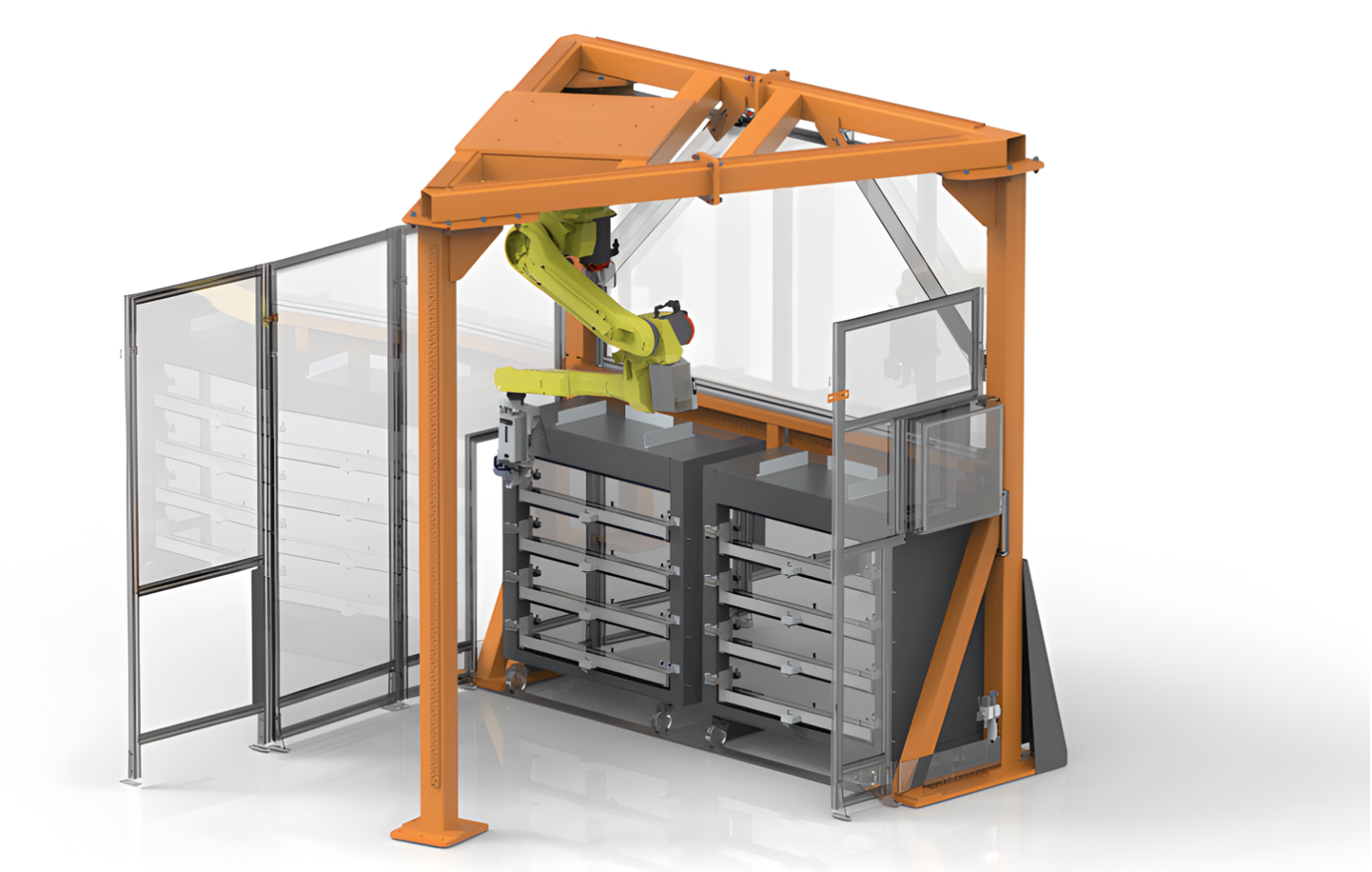
The Agile Engineered Machine Loading System provides custom manufacturing automation solutions for specialized production needs. Each system is built to automate complex machine tools, from grinders and lathes to injection molding and gantry loaders. Designed for precision and repeatability, these engineered cells help manufacturers increase throughput, reduce manual labor, and enable lights-out operation.
Agile Engineered Machine Loading System Cell Features:
Every Agile Engineered Machine Loading System is built to match specific shop requirements. This robot for machine tools handles repetitive loading and unloading tasks with speed and accuracy. These robots also interface directly with machine controls, vision systems, and conveyors to maintain consistent part flow. As a result, it reduces setup time, improves process stability, and ensures reliable production performance in high-demand machining environments.
The Agile Engineered Machine Loading System modernizes existing equipment through retrofit gantry loaders and automated part-transfer systems. This upgrade path allows manufacturers to adopt manufacturing automation solutions without replacing current assets. By adding robotic integration and modular controls, shops can optimize cycle times, maintain precision, and scale capacity with minimal downtime.
For hybrid manufacturing environments, the Agile Engineered Machine Loading System supports robotic integration with laser automation and secondary finishing processes. From laser trimming and marking to inspection and curing, these systems provide end-to-end control. As a result, engineers gain a unified, automated workflow that enhances consistency and reduces manual handling across every operation.
The Agile Engineered Machine Loading Systems is an custom robotic automation platform for special-purpose CNC loading applications. It is configured to move raw and completed workpieces between organized storage and the CNC machine while machinists remain available for setup, process control, inspection, and other skilled work. A.W. Miller Technical Sales supplies and supports Agile robotic machine-loading systems throughout New York, Pennsylvania, Maryland, Delaware, Southern New Jersey, and Quebec, with application review, cell integration, installation, training, and regional service.
Robot payload, reach, part presentation, guarding, peripherals, and controls are engineered for the application rather than selected from a fixed standard cell. The system can incorporate conveyors, vision, gauging, washing, marking, deburring, re-grip stations, and multi-machine service where required. Final system capacity must be confirmed with the complete part, gripper, robot reach, storage arrangement, machine interface, safety layout, cycle-time target, and unattended production plan.
Applications commonly evaluated for the Agile Engineered Machine Loading Systems include:
The system is developed from the production sequence, component geometry, takt requirement, and machine interfaces. This allows the robot, gripper, infeed, outfeed, and ancillary stations to be sized as one coordinated process.
Inspection, cleaning, marking, deburring, reorientation, or assembly steps can be added when they support the required production flow. Each station should have a defined purpose and measurable effect on throughput or quality.
Conveyors, pallets, drawers, carts, bins, or vision-guided picking can be selected around how raw and completed parts move through the facility. The presentation method must control orientation and buffer enough material for the target runtime.
Machine communication, cell sequencing, fault recovery, guarding, scanners, and operator access are validated around the full installation. Documentation and training should cover both normal production and safe recovery from interruptions.
The quoted robot payload is not the allowable part weight by itself. Gripper, jaws, adapters, one or two handled parts, reach, wrist orientation, acceleration, and part moment must all be included in the engineered load calculation.
The system uses its specified storage format to provide repeatable pickup locations and separate or reuse positions for completed parts. Nest design, spacing, orientation, and replenishment method are developed around the actual component.
Yes, when the storage, gripper, CNC workholding, programs, and tool capacity support those parts. Mixed production should be tested as a complete schedule so a change in jaws, tools, or inspection does not become the hidden constraint.
The safety design can include an integrated enclosure, floor scanner, fence, light barrier, interlocked access, and machine-door monitoring as applicable. The final arrangement requires a cell-specific risk assessment and validated stopping distances.
A.W. Miller helps define the application, machine interface, layout, workholding, gripper, part presentation, safety, commissioning, and operator training, then provides regional service support after production begins.