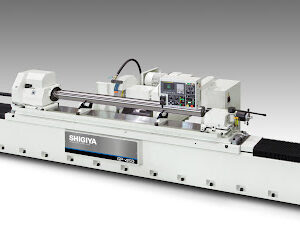

The Shigiya G-65D is a heavy-duty cylindrical grinder designed for precision grinding of large, high-mass workpieces. It delivers stable, repeatable results through a rigid machine platform, controlled thermal behavior, and consistent grinding performance across extended production runs. As a result, the G-65D supports reliable accuracy and predictable part quality in demanding, high-load manufacturing applications.
The Shigiya G-65D is a large capacity grinder built to meet the rigorous needs of industries that work with oversized components. It offers a generous swing over table of 650 mm (25.59 inches), making it ideal for handling wider parts. Additionally, this grinder supports up to 236 inches between centers, accommodating workpieces that weigh as much as 6,600 lbs. Because of this, it is especially useful in sectors like aerospace, shipbuilding, and energy production where part size and precision matter equally.
While many machines today rely heavily on automation, the G-65D stands out with its conventional cylindrical grinder design. Operators maintain full manual control, which allows for more intuitive adjustments during the grinding process. This manual precision is particularly valuable when dealing with unique or complex workpieces. Moreover, this setup gives experienced machinists the ability to fine-tune every detail. With smooth table travel and balanced controls, the grinder provides consistency throughout each operation, no matter the complexity of the part.
Beyond precision, the G-65D is a heavy-duty grinding machine engineered for durability and long-term use. Its robust construction keeps vibration to a minimum, even under the strain of continuous operation. As a result, surface finishes remain smooth and tolerances tight—even on heavy, lengthy parts. Furthermore, its sturdy frame supports consistent results shift after shift. By minimizing machine flex and thermal movement, the G-65D ensures accuracy without compromise. Over time, this reliability reduces wear and lowers maintenance needs.
The Shigiya G-65D adapts easily to different manufacturing environments. From job shops to large-scale production lines, this grinder provides flexibility without sacrificing accuracy. Its wide range of center lengths allows it to switch between short and long parts with minimal setup. In addition, the user-friendly design ensures operators can work efficiently without needing extensive training. For teams aiming to increase output while keeping tight tolerances, the G-65D is a valuable tool.
Metric
| Specifications | Units | |
|---|---|---|
| Swing Over Table | mm | 650 |
| Distance Between Centers | mm | 2200, 3000, 4000, 5000, 6000 |
| Weight Capacity | kg | 3000 |
Standard
| Specifications | Units | |
|---|---|---|
| Swing Over Table | inch | 25.59 |
| Distance Between Centers | inch | |
| Weight Capacity | lbs | 6613.87 |
The Shigiya G-65D is a large-capacity cylindrical grinder for large and heavy shafts requiring stable external cylindrical grinding. A.W. Miller Technical Sales supplies and supports Shigiya grinding equipment throughout New York, Pennsylvania, Maryland, Delaware, Southern New Jersey, and Quebec, with application engineering, installation, training, and factory-certified service.
The 65-class machine scales swing, grinding diameter, center distance, and work load for large components. Final capacity varies by model and bed length; the related large Shigiya platforms extend to multi-meter center distances and heavy between-centers loading. Final machine selection should be based on the complete workpiece, stock allowance, tolerance, surface finish, wheel and dressing package, workholding, gauging, coolant system, automation target, and production rate.
Applications commonly evaluated for the Shigiya G-65D include:
Workhead, tailstock, centers, steady rests, and loading equipment must support the full component mass without bending or damaging finished journals.
Grinding over extended center distances requires careful leveling, thermal stabilization, support placement, and verification of taper along the usable work length.
Abrasive type, grade, bond, wheel dimensions, dress form, and dressing interval must be matched to material, stock allowance, finish, and cycle time. The G-65D process should be validated with the complete wheel and coolant package.
Centers or chucking, drive method, support, coolant filtration, temperature control, and gauge strategy determine whether the G-65D can hold the required size, roundness, cylindricity, and surface finish through production.
G-65D is most valuable when its large-capacity cylindrical grinder configuration directly addresses the part’s size, feature access, work support, or production sequence. Selection should be based on a documented process advantage rather than model familiarity.
Confirm which surfaces require straight, angular, internal, face, or specialty access; then check wheel diameter, width, swivel or approach, guard clearance, dressing location, and interference with workholding.
Yes, but hardened steel, stainless, carbide, coatings, and other materials can require different abrasives, bonds, speeds, coolant, filtration, dress tools, and stock allowances. Cross-contamination and changeover should also be considered.
Common contributors include thermal change, wheel wear, dress variation, part deflection, center condition, coolant temperature, gauge repeatability, stock variation, and inconsistent spark-out. Process data should identify the dominant source before compensation is changed.
Foundation, leveling, vibration from nearby equipment, ambient temperature, power, air, coolant system, mist collection, material handling, and maintenance access all affect long-term performance and should be reviewed before delivery.