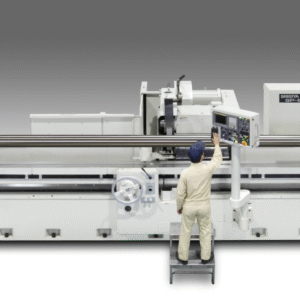

The Shigiya GPC-20 is a compact cylindrical grinder built for high-precision production of small to medium-sized components. It delivers consistent accuracy through a rigid machine structure, stable thermal performance, and smooth, repeatable grinding motion. As a result, the GPC-20 supports efficient production while maintaining tight tolerances and dependable part quality.
The GPC-20 is a compact, high-performance high-precision grinding machine engineered for small components and tight tolerances. It provides consistent grinding results across small-diameter parts, even under continuous operation. This makes it ideal for toolmakers, aerospace suppliers, and medical device manufacturers. Because of its thermally stable structure and rigid construction, this high-precision grinding machine maintains accuracy over long cycles. Shops that need reliable performance in a compact footprint benefit from its precision and repeatability.
Designed as a small parts grinding machine, the GPC-20 is optimized for intricate workpieces and space-limited production areas. It offers precise control and consistent finish quality, even on complex shapes. Additionally, the GPC-20 simplifies part handling and speeds up cycles without sacrificing accuracy. As a small parts grinding machine, it supports efficient workflows and reduced scrap rates, making it well-suited for high-mix, low-volume operations.
To meet growing production demands, the GPC-20 integrates seamlessly into automated grinding solutions. Its open CNC control system connects easily with robotic loaders, conveyors, and in-line inspection. These automated grinding solutions help manufacturers cut labor costs and increase part flow. With the GPC-20, shops can scale production without compromising quality or precision.
The GPC-20 functions as reliable precision machining equipment, especially for facilities focused on lean operations. It reduces cycle times while maintaining consistent surface finishes and dimensional accuracy. Moreover, this precision machining equipment helps manufacturers stay competitive by combining accuracy, speed, and long-term reliability.
With its programmable control and automated features, the GPC-20 supports efficient CNC grinding automation. Operators can set up and run multiple jobs without constant supervision. Because of its ease of integration, this CNC grinding automation platform increases uptime and reduces human error—ideal for shops looking to grow with automation-ready systems.
Metric
| Specifications | Units | |
|---|---|---|
| Swing Over Table | mm | 200 |
| Distance Between Centers | mm | 100 |
| Weight Capacity | kg | 20 |
| Machine Weight | kg | 1500 |
| Wheel Size OD | mm | 355 |
| Wheel size width | mm | 38/50* |
| Wheel spindle | KW | 2.2 |
Standard
| Specifications | Units | |
|---|---|---|
| Swing Over Table | inch | 7.87 |
| Distance Between Centers | inch | 3.94 |
| Weight Capacity | lbs | 44.09 |
| Machine Weight | Ibs | 3306.93 |
| Wheel Size OD | inch | 13.98 |
| Wheel size width | inch | 1.5 / 1.97* |
| Wheel spindle | HP | 2.95 |
The Shigiya GPC-20 is a compact CNC cylindrical grinder for production shaft and chucking work within a space-conscious grinding platform. A.W. Miller Technical Sales supplies and supports Shigiya grinding equipment throughout New York, Pennsylvania, Maryland, Delaware, Southern New Jersey, and Quebec, with application engineering, installation, training, and factory-certified service.
The 20-class GPC platform combines programmable cylindrical grinding with a compact machine layout. Swing, center distance, wheel package, work load, and automation readiness vary by model and should be matched to the complete fixture and part. Final machine selection should be based on the complete workpiece, stock allowance, tolerance, surface finish, wheel and dressing package, workholding, gauging, coolant system, automation target, and production rate.
Applications commonly evaluated for the Shigiya GPC-20 include:
The machine concentrates programmable OD grinding in a smaller footprint for facilities and cells where floor space is limited.
Compact work zones can reduce robot reach and transfer distance, provided doors, chucking, gauging, and finished-part handling are coordinated.
Abrasive type, grade, bond, wheel dimensions, dress form, and dressing interval must be matched to material, stock allowance, finish, and cycle time. The GPC-20 process should be validated with the complete wheel and coolant package.
Centers or chucking, drive method, support, coolant filtration, temperature control, and gauge strategy determine whether the GPC-20 can hold the required size, roundness, cylindricity, and surface finish through production.
The 20-class GPC platform combines programmable cylindrical grinding with a compact machine layout. Swing, center distance, wheel package, work load, and automation readiness vary by model and should be matched to the complete fixture and part. The correct size is the smallest configuration that clears the complete part and workholding while meeting load, wheel, and process requirements.
Yes, when the wheel access, program, work support, and gauge plan allow it. Each diameter and shoulder must be checked for collision, stock condition, wheel form, dwell, traverse direction, and dressing demand.
Automation may include loading, chuck or center confirmation, in-process gauging, wheel dressing, part washing, and discharge. A stable manual process should be proven before unattended recovery logic is finalized.
Wheel specification and condition, dress parameters, work speed, traverse or plunge rate, spark-out, coolant delivery, vibration, and incoming stock all affect finish. A slower feed alone does not correct an unstable grinding system.
Flow, pressure, temperature stability, nozzle placement, filtration level, tank capacity, and material contamination must support both the wheel and tolerance. The coolant system should be treated as part of the machine process.