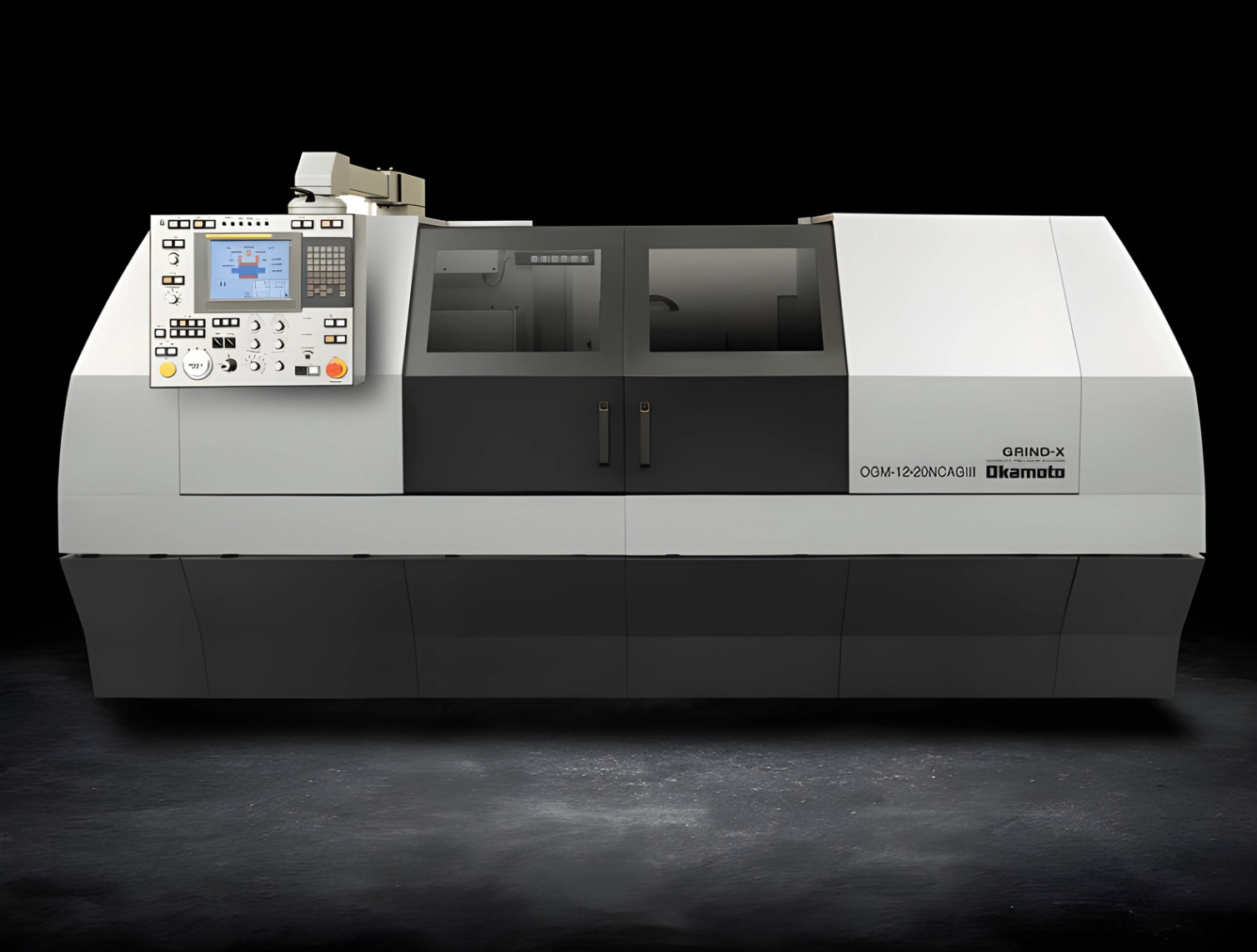
The Okamoto OGM 1224NCAGIII combines simultaneous O.D. and shoulder grinding with CNC process control for precision production applications. Its angle-head configuration, rigid cast construction, 15 hp spindle, and automatic wheel dressing support efficient material removal while maintaining part geometry and surface finish. Conversational programming also simplifies setup across changing production requirements.
OGM 1224NCAGIII Features:
Simultaneous O.D. and shoulder grinding
Angle-head configuration for multi-surface grinding
FANUC 0i-TD CNC control
Okamoto conversational programming
15 hp grinding wheel spindle motor
Ultra-rigid cast construction
Automatic wheel dressing
Automatic dress wear compensation
Optional ballscrew upgrade for extra heavy-duty applications
Universal work head with dead/live center capability
Marposs shoulder flagging device
Standard door safety interlock
Max Table Travel
33.5"
Maximum Part Diameter
12"
Description
Simultaneous OD and Shoulder Grinding
The Okamoto OGM 1224NCAGIII is an angle head cylindrical grinder built for precision production applications requiring efficient processing of multiple part features. Its angle-head configuration enables simultaneous O.D. and shoulder grinding, reducing separate grinding operations and supporting shorter cycle times. Ultra-rigid cast construction provides a stable platform for maintaining dimensional accuracy and surface finish during demanding production runs.
CNC Control for Precision Production Grinding
A FANUC 0i-TD CNC with Okamoto conversational software provides control over grinding parameters while simplifying machine setup and programming. The machine combines CNC process control with a 15 hp grinding wheel spindle for consistent material removal across short runs and high production grinding applications. An optional ballscrew upgrade is available for applications requiring additional capability during extra heavy-duty grinding.
Automatic Dressing and Process Control
Automatic dressing with dress wear compensation helps maintain wheel geometry as production continues. This supports consistent part accuracy without requiring operators to manually compensate for normal wheel wear. A fully enclosed work area and standard door interlock provide additional protection during operation. Together, these systems make the OGM 1224NCAGIII suitable for manufacturers requiring repeatable CNC cylindrical grinding across demanding production environments.
Standard Accessories
Okamoto Conversational Software
Remote Manual Pulse Generator
Marposs Shoulder Flagging Device
Universal Work Head (Dead/Live Center)
Grinding Wheel and Wheel Adaptor
Dressing Device with Diamonds
Carbide Tip Center
Tail Stock with Taper Adjustment
Door Interlock
LED Work Light
Optional Accessories
Coolant System with Paper Filter and Magnetic Separator
Okamoto OGM 1224NCAGIII Capabilities, Applications & Regional Support
The Okamoto OGM 1224NCAGIII is a CNC angle-head cylindrical grinder built around simultaneous or coordinated OD and shoulder grinding for shaft-type components. Its value is determined by how well the grinding architecture matches the surfaces that control part function, including their size, form, finish, and relationship to adjacent features. A.W. Miller Technical Sales supports Okamoto grinding applications throughout New York, Pennsylvania, Maryland, Delaware, Southern New Jersey, and Quebec, providing applications engineering, installation, training, and factory-certified service.
For the OGM 1224NCAGIII, the part drawing should drive the process plan. Bore or surface geometry, tolerance, material condition, stock allowance, wheel specification, dressing frequency, coolant control, and gauging should be defined before the final machine configuration is selected.
Applications
Parts and processes commonly evaluated for the Okamoto OGM 1224NCAGIII include:
stepped shafts
bearing journals
spindles
drive components
Why Manufacturers Choose the Okamoto OGM 1224NCAGIII
Angle-Head Grinding Strategy
The wheelhead arrangement is intended to address outside diameters and shoulders efficiently without treating them as unrelated operations.
Shoulder-to-Diameter Geometry
Grinding adjacent faces and diameters within the same controlled setup helps maintain squareness and axial relationships.
CNC Cylindrical Processing
Programmable grinding cycles support recurring stepped-shaft work where multiple diameters and shoulders must be sequenced consistently.
Reduced Rehandling
Combining related cylindrical and shoulder operations can remove transfers between separate grinding setups when the part is a fit.
It allows the process to address OD surfaces and shoulders efficiently, making it useful for components where journal diameter and shoulder geometry are closely related.
Stepped shafts, spindles, bearing journals, and drive components with multiple ODs and shoulders are common application types.
Potentially. If the required shoulder surfaces are accessible within the angle-head process, they can be coordinated with OD grinding in the same setup.
Center condition, chucking, tailstock support, work-rest requirements, part stiffness, stock condition, and grinding-force direction all affect the process.
Representative part drawings, maximum diameter and length, shoulder geometry, tolerance, finish, material, wheel requirements, gauging, coolant, and production quantities should be reviewed together.
Related products
Select options
This product has multiple variants. The options may be chosen on the product page

 This product has multiple variants. The options may be chosen on the product page
 This product has multiple variants. The options may be chosen on the product page