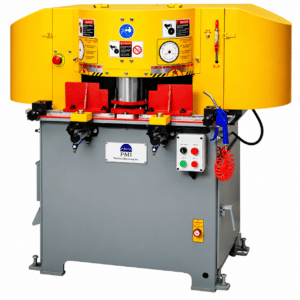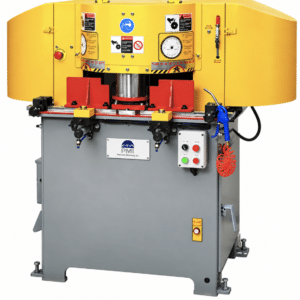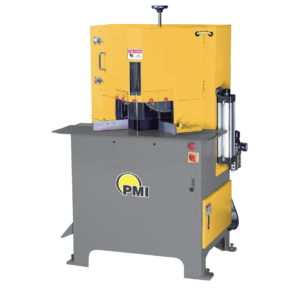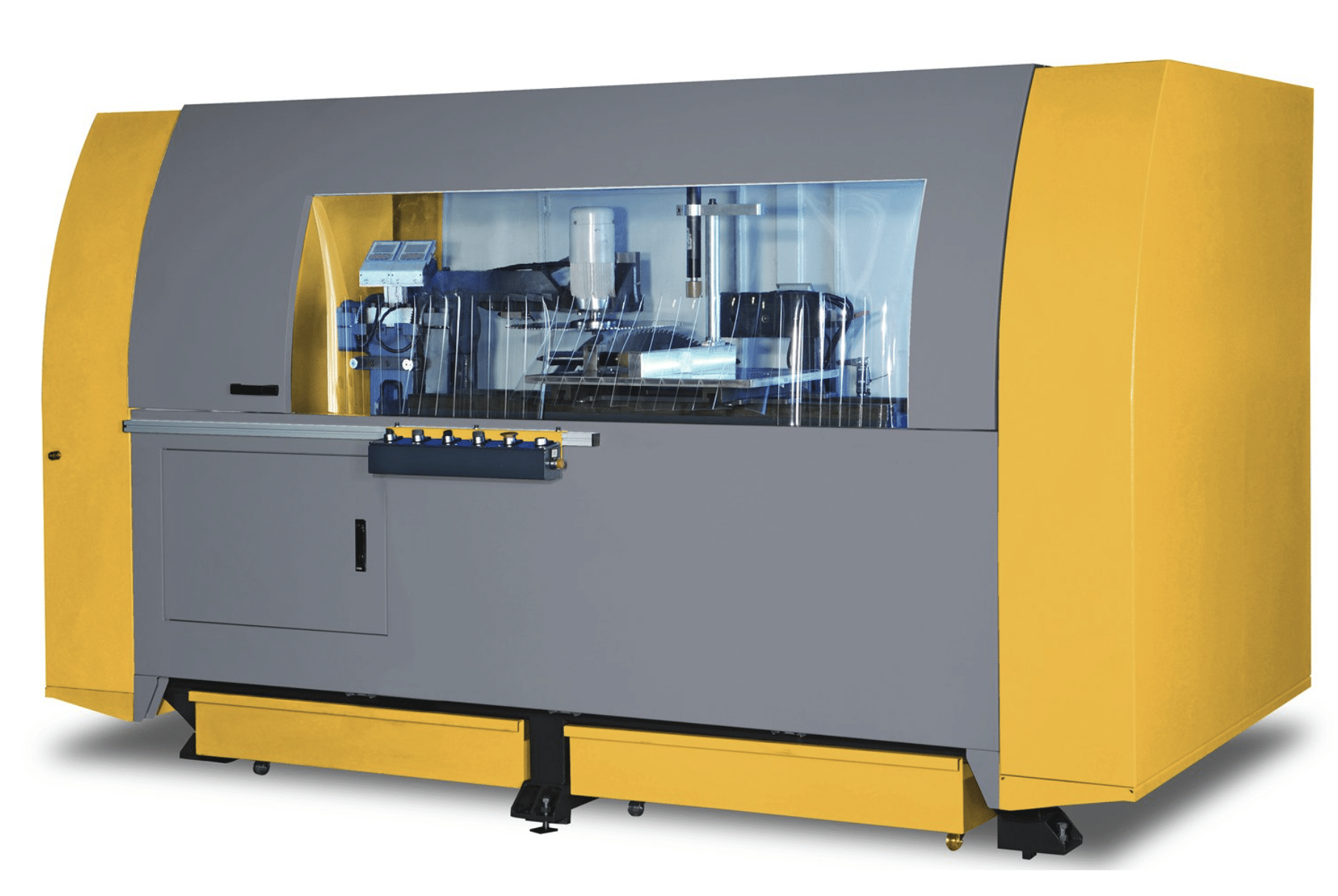
Notching aluminum profiles often requires cuts on more than one face and at more than one angle. The PMI-LJK 500NC Notching Saw brings those operations together with vertical and horizontal cutting capability controlled through an NC system. Servo-controlled angle positioning adds flexibility for changing notch geometry, giving manufacturers a dedicated platform for preparing aluminum extrusions and profiles before assembly, welding, or other downstream operations.
PMI-LJK 500NC Notching Saw Features:
The PMI-LJK 500NC is an automatic aluminum profile notching saw developed for production work where profiles require material to be removed before joining or assembly. Rather than treating each notch as a separate manual setup, the machine brings controlled positioning and cutting functions into a dedicated notching platform for recurring aluminum extrusion work.
Different profile designs can require access to more than one surface of the workpiece. The NC vertical horizontal profile notcher provides both cutting orientations within the same machine, expanding the range of notch configurations that can be produced without transferring the extrusion between separate saws or setups.
Angle positioning adds another level of control when the required notch is not limited to a basic square cut. As a servo angle aluminum notch saw, the PMI-LJK 500NC uses controlled angular positioning to accommodate changing profile geometry and notch requirements. This makes the machine particularly useful for recurring components where notch location and angle need to remain consistent across a production run.
| Specification | Value |
| Machine Type | NC aluminum profile notching saw |
| Blade Arrangement | Vertical and horizontal |
| Vertical Blade | 26 in published |
| Horizontal Blade | 20 in published |
| Saw Motors | 3 HP x 2 |
| Blade Speed | 2,800 RPM |
| Standard Cutting Capacity | Approximately 6 x 6 in |
The Pat Mooney PMI-LJK 500NC Notching Saw is a NC two-head notching saw with independently positioned vertical and horizontal blades. Its operating format, head arrangement, and working range define where it fits within aluminum and non-ferrous production.
A 24-inch vertical blade and 20-inch horizontal blade are driven by separate 5-hp motors at 2,800 rpm. Each head rotates through 45 degrees in either direction, the table rotates ±45 degrees, and air-over-oil feed supports an 8.67 × 6.7-inch cutting depth. Final machine selection depends on the complete material range, profile geometry, required angles or features, finished length, tolerance, production volume, blade requirements, clamping, material support, and part handling.
Common applications include:
Both heads and the worktable rotate independently through ±45 degrees.
A 24-inch vertical blade and 20-inch horizontal blade address different sides of the notch.
Controlled angular setup supports repeatable multi-plane notch geometry.
Separate cuts create profiles that a single fixed-angle notcher cannot produce.
The vertical head, horizontal head, and worktable each rotate through 45 degrees left and right.
The vertical station uses a 24-inch blade and the horizontal station a 20-inch blade, matching the two cutting orientations and published work envelope.
The official specification lists 8.67 inches by 6.7 inches. Part orientation and selected angles affect usable clearance.
It allows independent head and table angle changes, enabling compound and asymmetric notch geometry rather than one fixed notch form.
The 600NC uses 24-inch blades on both heads and expands the published depth to 8.67 × 8.67 inches.