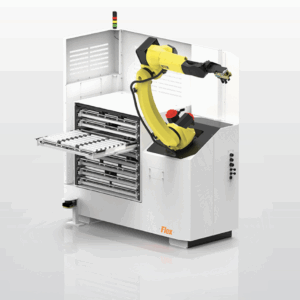
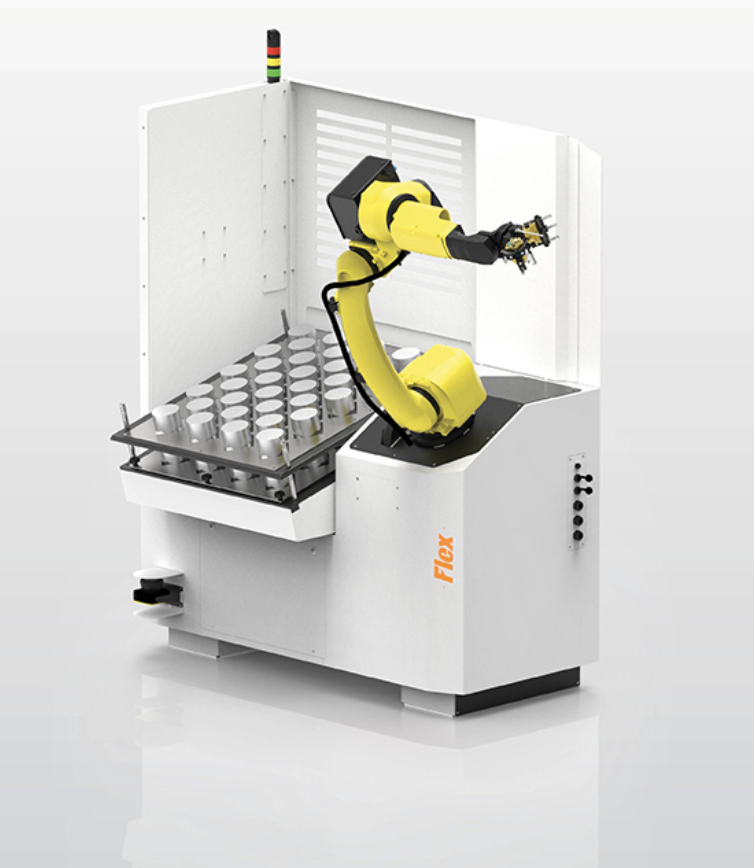
The Agile Flex 12P robotic automation solutions empower manufacturers with an intelligent, efficient, and adaptable automated loading system for CNC machines. Engineered for precision, scalability, and long-term reliability, it’s designed to streamline material handling, maximize spindle utilization, and minimize manual intervention.
Agile Flex 12P Features:
The Agile Flex 12P robotic automation solutions are engineered to optimize CNC production workflows and reduce manual involvement. For example, they feature a compact footprint and integrated control interface, making them ideal for high-precision machining environments. In addition, the high-speed robotic arm and adaptive gripper technology ensures seamless material transitions between cycles. with decreased operator intervention. As a result, the Agile Flex 12P provides manufacturers with a reliable, repeatable automation platform that decreases operator intervention while improving throughput, and process consistency in small to medium production runs.
This automated loading system for CNC applications maximizes productivity by managing complex loading and unloading sequences. For example, its modular construction allows engineers to configure the system for varying part geometries and production objectives. In addition, the integrated vision system ensures precise part positioning, while reducing setup times and alignment errors. As a result, it’s capable of efficient, continuous machining, consistent part quality, and reduced operator fatigue and human error.
The Agile Flex 12P load robotic system eliminates complex programming steps, and offers an intuitive interface for quick setup and on-the-fly process adjustments. Capable of handling diverse payloads and part configurations, the system efficiently manages both raw materials and finished components. Beyond performance gains, it promotes a safer, more efficient work environment by automating repetitive manual tasks and enabling lights-out manufacturing. Built for future-ready operations, the Agile Flex 12P aligns seamlessly with Industry 4.0 strategies, empowering manufacturers to embrace the next generation of smart automation.
| Agile Flex 12P | |
| General | |
| Agile control software | Standard |
| Included standard nest plates (double layer) | 1 |
| Additional nest plates | Option |
| Power supply (KvA) | 2 |
| Pneumatic pressure (bar) | 6 |
| Robot | |
| Fanuc M-10iD/12 robot (12kg payload) | Standard |
| Double 3-jaw gripper | Standard |
| Gripper pressure control | Standard |
| Capacities | |
| Workpiece diameter (min/max) | 1” – 4” / 25mm – 100mm |
| Workpiece length | >12” / >300mm (application dependant) |
| Workpiece weight – single gripping (max) | 18lbs / 8kg |
| Workpiece weight – double gripping (max) | 9lbs / 4kg |
| Weight capacity – pallet (max) | 550lbs / 250kg |
| Standard nest plate capacity ø0.75” – ø4” / ø20mm – ø100mm (pieces) | 32 |
| Standard nest plate capacity ø0.75” – ø2.5” / ø20mm – ø63mm (pieces) | 72 |
| Standard nest plate capacity ø0.75” – ø1.375” / ø20mm – ø35mm (pieces) | 179 |
| Safety | |
| Floor scanner | Standard |
| Integrated enclosure | Standard |
| Safety fence | Option |
The Agile Flex 12P is an compact pallet-based robotic loading system for smaller CNC-machined parts. It is configured to move raw and completed workpieces between organized storage and the CNC machine while machinists remain available for setup, process control, inspection, and other skilled work. A.W. Miller Technical Sales supplies and supports Agile robotic machine-loading systems throughout New York, Pennsylvania, Maryland, Delaware, Southern New Jersey, and Quebec, with application review, cell integration, installation, training, and regional service.
A FANUC M-10iD/12 robot with a 12 kg payload and double three-jaw gripper is standard. Published capacity covers 1- to 4-inch workpiece diameters, double-gripped parts up to 9 lbs, application-dependent lengths beyond 12 inches, and a maximum pallet load of 500 lbs. Final system capacity must be confirmed with the complete part, gripper, robot reach, storage arrangement, machine interface, safety layout, cycle-time target, and unattended production plan.
Applications commonly evaluated for the Agile Flex 12P include:
A double-layer standard nest plate organizes raw and completed parts without the vertical segmentation of drawers. The open format supports visual inventory checks and adaptable part spacing.
Published nest options provide from 32 to 179 positions depending on diameter range. Part length, gripper approach, raw-stock variation, and finished-part allocation determine usable capacity.
The robot class is matched to smaller components and compact machine tools. The complete payload calculation includes both handled parts, gripper, jaws, and any custom adapters used during exchange.
Nest plates and Agile software parameters can be prepared for recurring part families. Reliable changeover also requires the correct CNC program, workholding, tooling, and inspection plan.
The quoted robot payload is not the allowable part weight by itself. Gripper, jaws, adapters, one or two handled parts, reach, wrist orientation, acceleration, and part moment must all be included in the engineered load calculation.
The system uses its specified storage format to provide repeatable pickup locations and separate or reuse positions for completed parts. Nest design, spacing, orientation, and replenishment method are developed around the actual component.
Yes, when the storage, gripper, CNC workholding, programs, and tool capacity support those parts. Mixed production should be tested as a complete schedule so a change in jaws, tools, or inspection does not become the hidden constraint.
The safety design can include an integrated enclosure, floor scanner, fence, light barrier, interlocked access, and machine-door monitoring as applicable. The final arrangement requires a cell-specific risk assessment and validated stopping distances.
A.W. Miller helps define the application, machine interface, layout, workholding, gripper, part presentation, safety, commissioning, and operator training, then provides regional service support after production begins.