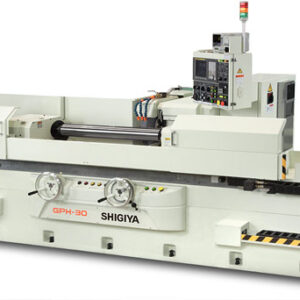
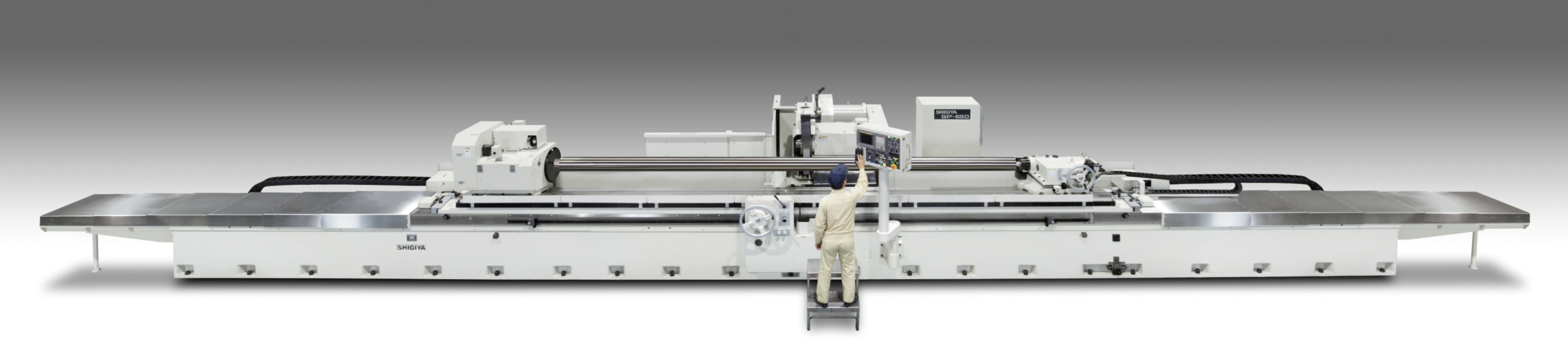
The Shigiya GP-100D is a heavy-duty cylindrical grinder designed for high-precision grinding of large-diameter, high-mass components. It delivers stable, repeatable accuracy through an extremely rigid machine structure, controlled thermal behavior, and consistent grinding performance over long production cycles. As a result, the GP-100D supports dependable throughput and consistent part quality in demanding large-part manufacturing applications.
The GP-100D is a heavy-duty large workpiece grinding machine engineered for long and oversized parts. It handles large shafts, rollers, and cylindrical components while keeping tolerances tight. Its generous swing and long-distance between centers make it a smart fit for energy, aerospace, and defense work. Because this large workpiece grinding machine stays stable under load, it ensures consistent results—regardless of part length or material.
The GP-100D also functions as a table-traversing cylindrical grinder. Its servo-driven table glides smoothly over extended lengths. As a result, the machine maintains precision and part alignment throughout each pass. In addition, the rigid base and guideways help reduce vibration. This design improves finish quality and supports long-term repeatability. Shops looking to grind long parts will benefit from this table-traversing cylindrical grinder setup.
The GP-100D serves as dependable high-precision grinding equipment. It uses a high-torque spindle, temperature-controlled systems, and rigid drives to maintain tight tolerances. Because the GP-100D provides accurate, repeatable grinding, manufacturers can meet exacting specs with confidence. As reliable high-precision grinding equipment, it fits into both high-mix and high-output operations.
The GP-100D supports modern industrial grinding solutions. It integrates with automation systems, including part loaders and conveyors. This streamlines workflows and reduces downtime. Moreover, these industrial grinding solutions help shops scale output without adding labor. The GP-100D enhances throughput while maintaining part consistency across shifts.
Metric
| Specifications | Units | |
|---|---|---|
| Swing Over Table | mm | 1000 |
| Distance Between Centers | mm | 2200, 3000, 4000, 5000, 6000 |
| Weight Capacity | kg | 3000 |
| Machine Weight | kg | 22,000 / 24,000 / 26,000 / 29,000 |
| Wheel Size OD | mm | 915 / 1065 |
| Wheel size width | mm | 130* |
| Wheel spindle | KW | 15 / 22 |
Standard
| Specifications | Units | |
|---|---|---|
| Swing Over Table | inch | 39.37 |
| Distance Between Centers | inch | 86.62 / 118.11 / 157.48 / 196.85 / 236.22 |
| Weight Capacity | lbs | 6613.87 |
| Machine Weight | Ibs | 48501.7 / 52910.94 / 57320.19 / 63934.06 |
| Wheel Size OD | inch | 36.02 / 41.93 |
| Wheel size width | inch | 5.12* |
| Wheel spindle | HP | 20.12/ 29.5 |
The Shigiya GP-100D is a large CNC cylindrical grinder for programmable OD grinding on large-diameter and long components. A.W. Miller Technical Sales supplies and supports Shigiya grinding equipment throughout New York, Pennsylvania, Maryland, Delaware, Southern New Jersey, and Quebec, with application engineering, installation, training, and factory-certified service.
The 100-class GP-D platform is part of Shigiya’s large table-traverse range. Published GP-65/85/100D data covers 650, 850, and 1,000 mm swing classes, center distances extending to several meters, loads up to 3,000 kg, and a 915 mm grinding wheel. Final machine selection should be based on the complete workpiece, stock allowance, tolerance, surface finish, wheel and dressing package, workholding, gauging, coolant system, automation target, and production rate.
Applications commonly evaluated for the Shigiya GP-100D include:
CNC wheelhead and table control coordinate multiple diameters, shoulders, and traverse zones across long, heavy parts.
Center load, drive torque, steady-rest placement, and crane access must be developed around the real shaft rather than maximum catalog dimensions alone.
Abrasive type, grade, bond, wheel dimensions, dress form, and dressing interval must be matched to material, stock allowance, finish, and cycle time. The GP-100D process should be validated with the complete wheel and coolant package.
Centers or chucking, drive method, support, coolant filtration, temperature control, and gauge strategy determine whether the GP-100D can hold the required size, roundness, cylindricity, and surface finish through production.
The difference is not limited to nominal swing. Center distance, grinding diameter, supported mass, wheel size, machine footprint, loading method, and available options may change, so both models should be compared against the same representative part family.
It can be configured for precision grinding, but achievable capability depends on part geometry, support, stock, wheel condition, thermal control, setup, and measurement. A process study should define the expected tolerance distribution.
Options may include grinding between centers, chucking, special arbors, center-drive arrangements, steady rests, and dedicated fixtures. Selection follows the part datums, drive torque, accessibility, distortion risk, and finished-surface protection.
In-process gauging is valuable when wheel wear, thermal drift, incoming stock, or long unattended runs could move size outside the required range. Gauge location and compensation logic must be compatible with the feature and cycle.
Provide the full print, material and hardness, starting diameters, stock allowance, grinding lengths, tolerance, finish, wheel specification, dress method, loading time, gauge steps, spark-out, and annual volume.