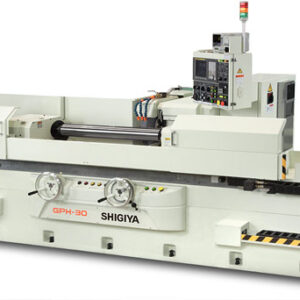

The Shigiya GP-85D is a large-capacity cylindrical grinder built for high-precision grinding of very large, heavy workpieces. It delivers stable, repeatable accuracy through an exceptionally rigid machine structure, controlled thermal performance, and consistent grinding behavior during extended production cycles. As a result, the GP-85D supports reliable throughput and consistent part quality in demanding large-part manufacturing environments.
The GP-85D is robust, reliable high-precision grinding equipment designed for large components that require accuracy, stability, and performance. Built for manufacturers handling oversized parts, it delivers consistent tolerances even in continuous, heavy-duty operations. Because it incorporates rigid structural components and a thermally stable frame, this high-precision grinding equipment supports fine surface finishes and dimensional control over long production runs. Its configuration allows precise machining of shafts, rollers, and high-value industrial parts.
As production demands increase, shops need dependable industrial grinding solutions that deliver both throughput and repeatability. The GP-85D answers that need with a design tailored to long, heavy parts. With high-torque motors, programmable control systems, and advanced guideways, the machine provides durable, scalable industrial grinding solutions for aerospace, energy, and large-scale machining. Its footprint and capabilities make it a strong fit for shops managing complex part geometries and tight deadlines.
The GP-85D was engineered to perform CNC grinding for large components with efficiency and control. Its wheel head movement and worktable capacity support grinding of oversized parts without compromising finish quality or cycle time. Since the system ensures uniform grinding across long parts, this CNC grinding for large components setup is especially useful for manufacturers working with long shafts, large bearings, and industrial rollers.
Although optimized for size, the GP-85D remains a versatile cylindrical grinding machine. It adapts to different workpiece shapes and materials with ease. Its flexible tooling and intuitive CNC interface allow operators to change setups quickly and maintain productivity. This versatile cylindrical grinding machine supports both repeat production and custom one-offs, which helps shops stay competitive in dynamic manufacturing markets.
The GP-85D integrates advanced CNC grinding technology to enhance precision, stability, and efficiency. With servo-controlled axes and digital feedback systems, the machine maintains tight tolerances in all grinding phases. As manufacturing standards rise, this advanced CNC grinding technology ensures that shops meet evolving customer specs while reducing downtime and error rates.
Metric
| Specifications | Units | |
|---|---|---|
| Swing Over Table | mm | 850 |
| Distance Between Centers | mm | 2200, 3000, 4000, 5000, 6000 |
| Weight Capacity | kg | 3000 |
| Machine Weight | kg | 21,500 / 23,500 / 25,500 / 28,500 |
| Wheel Size OD | mm | 915 / 1065 |
| Wheel size width | mm | 130* |
| Wheel spindle | KW | 15 / 22 |
Standard
| Specifications | Units | |
|---|---|---|
| Swing Over Table | inch | 33.46 |
| Distance Between Centers | inch | 86.62 / 118.11 / 157.48 / 196.85 / 236.22 |
| Weight Capacity | lbs | 6613.87 |
| Machine Weight | Ibs | 47399.39 / 51808.63 / 56217.88 / 62831.74 |
| Wheel Size OD | inch | 36.02 / 41.93 |
| Wheel size width | inch | 5.12* |
| Wheel spindle | HP | 20.12 / 29.5 |
The Shigiya GP-85D is a large CNC cylindrical grinder for programmable OD grinding on large-diameter and long components. A.W. Miller Technical Sales supplies and supports Shigiya grinding equipment throughout New York, Pennsylvania, Maryland, Delaware, Southern New Jersey, and Quebec, with application engineering, installation, training, and factory-certified service.
The 85-class GP-D platform is part of Shigiya’s large table-traverse range. Published GP-65/85/100D data covers 650, 850, and 1,000 mm swing classes, center distances extending to several meters, loads up to 3,000 kg, and a 915 mm grinding wheel. Final machine selection should be based on the complete workpiece, stock allowance, tolerance, surface finish, wheel and dressing package, workholding, gauging, coolant system, automation target, and production rate.
Applications commonly evaluated for the Shigiya GP-85D include:
CNC wheelhead and table control coordinate multiple diameters, shoulders, and traverse zones across long, heavy parts.
Center load, drive torque, steady-rest placement, and crane access must be developed around the real shaft rather than maximum catalog dimensions alone.
Abrasive type, grade, bond, wheel dimensions, dress form, and dressing interval must be matched to material, stock allowance, finish, and cycle time. The GP-85D process should be validated with the complete wheel and coolant package.
Centers or chucking, drive method, support, coolant filtration, temperature control, and gauge strategy determine whether the GP-85D can hold the required size, roundness, cylindricity, and surface finish through production.
GP-85D is most valuable when its large cnc cylindrical grinder configuration directly addresses the part’s size, feature access, work support, or production sequence. Selection should be based on a documented process advantage rather than model familiarity.
Confirm which surfaces require straight, angular, internal, face, or specialty access; then check wheel diameter, width, swivel or approach, guard clearance, dressing location, and interference with workholding.
Yes, but hardened steel, stainless, carbide, coatings, and other materials can require different abrasives, bonds, speeds, coolant, filtration, dress tools, and stock allowances. Cross-contamination and changeover should also be considered.
Common contributors include thermal change, wheel wear, dress variation, part deflection, center condition, coolant temperature, gauge repeatability, stock variation, and inconsistent spark-out. Process data should identify the dominant source before compensation is changed.
Foundation, leveling, vibration from nearby equipment, ambient temperature, power, air, coolant system, mist collection, material handling, and maintenance access all affect long-term performance and should be reviewed before delivery.