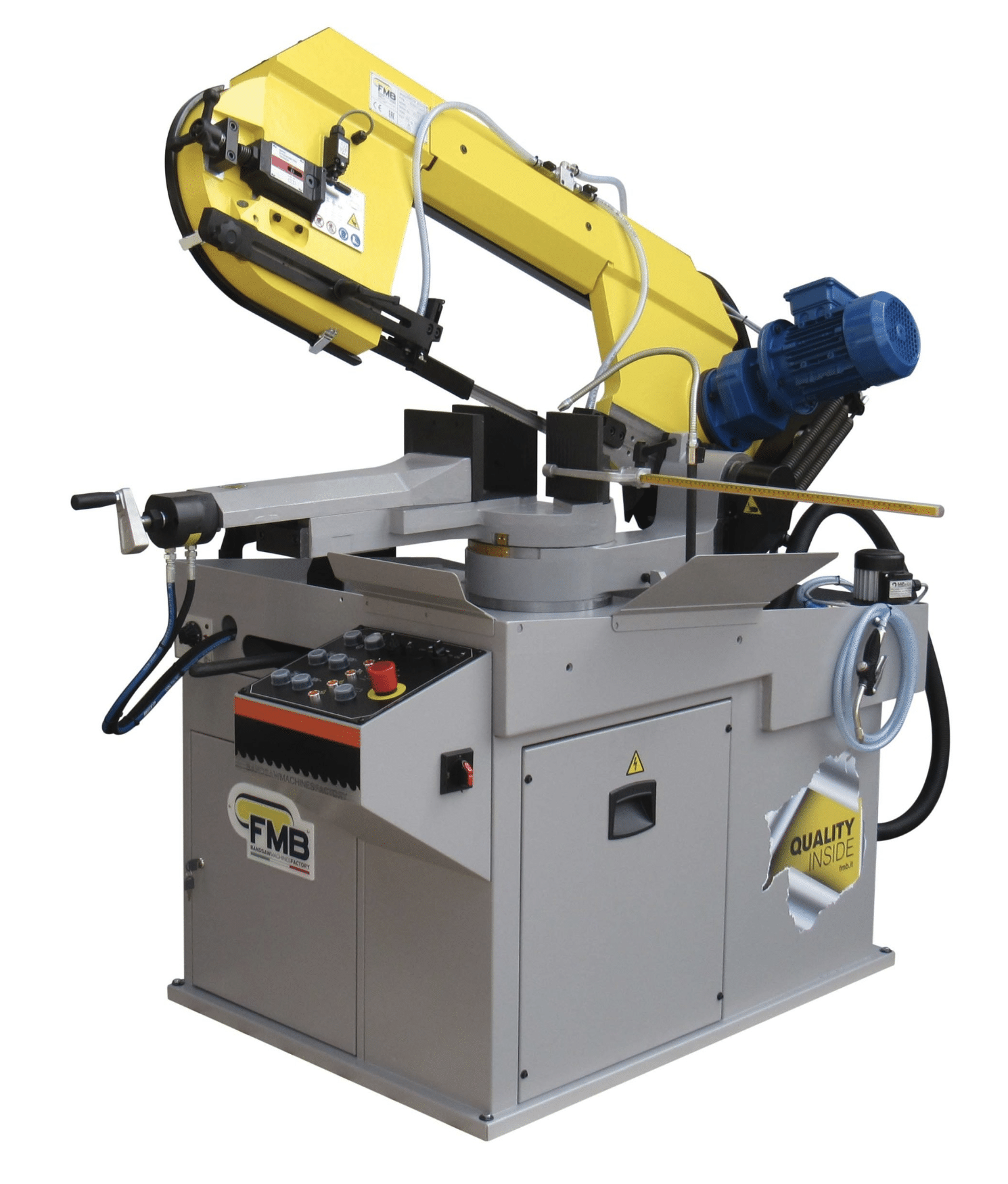
The FMB Mercury bandsaw brings semi-automatic cutting capabilities to applications involving larger metal stock and recurring cutoff operations. With 12-inch round cutting capacity, hydraulic saw-head operation, and a controlled cutting cycle, the Mercury is designed to process substantial bar, tubing, and structural sections with less operator involvement during each cut. Its configuration supports manufacturers that require consistent cutting performance across changing material sizes and production quantities without the complexity of a fully automatic indexing system.
Mercury Features:
The Mercury is a 12 inch semi automatic bandsaw designed to process larger metal sections while reducing the manual effort associated with each cutting cycle. Hydraulic saw-head operation provides controlled blade advancement through the material, making the machine suitable for substantial round stock, tubing, and structural profiles. This configuration allows operators to concentrate on material positioning and preparation rather than manually controlling the saw head throughout every cut.
Maintaining appropriate blade feed is particularly important when cutting larger cross sections, where material engagement can change throughout the cutting stroke. The FMB Mercury bandsaw uses hydraulic cutting control to regulate saw-head movement and support consistent cutting conditions. This helps manufacturers manage the demands of heavier stock while maintaining a repeatable process across successive workpieces.
For manufacturers producing repeated cut lengths but handling different materials throughout the day, the Mercury provides an alternative to fully automatic sawing equipment. As a production cutoff bandsaw, it supports recurring cutting operations while leaving material loading and positioning under operator control. This arrangement is well suited to machine shops and fabrication departments that require semi-automatic cutting performance without dedicating equipment to a single high-volume production application.

| Cutting Capacity | 0° | 45° Right | 60° | Bundle |
| Round | 12 in | 10-1/4 in | 6-3/4 in | — |
| Rectangle A | 12 x 14-1/2 in | 6 x 10⁻¹/4 in | 6-1/4 x 6-3/4 in | 5-1/2 x 11 in |
| Rectangle B | — | 12 x 8-5/8 in | 10 x 6 in | — |
| Square | 12 x 12 in | 9-1/2 x 9-1/2 in | 6-1/4 x 6-1/4 in | — |
| Blade Size | 11 ft 3 in x 1 in x .035 in |
| Blade Speed | 52–394 FPM |
| Saw Motor Power | 2 HP |
| Voltages | 220V/3PH, 440V/3PH, 220V/1PH |
| Footprint | 39 x 67 in |
| Weight | 1,425 lbs |
A semi-automatic miter bandsaw for production fabrication, the Pat Mooney Mercury is designed around semi-automatic fabrication batches. The model’s specific motion and capacity are more important than the family name alone.
The FMB Mercury is a semi-automatic miter bandsaw for bar, tube, and structural work. Hydraulic head control and clamping support repeatable production cutting. Before release, verify the part drawing against the machine envelope, motion range, blade or spindle requirements, clamp access, material flow, finished-part support, and required throughput.
Representative applications include:
The FMB Mercury is a semi-automatic miter bandsaw for bar, tube, and structural work. Hydraulic head control and clamping support repeatable production cutting.
The usable work envelope changes with head angle and material orientation, so the required cut must be checked against the capacity chart.
Blade tooth selection, speed, and downfeed are established from material grade, wall thickness, and tooth engagement.
Vise contact and correctly positioned infeed and outfeed supports keep the stock aligned through the blade path.
The operator establishes length and angle, loads the stock, and starts the cycle; the machine controls clamping, cutting, and head return.
Mercury suits recurring production where powered cycle functions matter, while Mercury GV retains gravity feed for simpler walk-away cutting.
Yes, provided the profile fits the angle-specific envelope and the blade pitch and vise pressure are appropriate for the wall thickness.
Confirm squareness, burr, blade tracking, feed pressure, tooth load, coolant delivery, and vise contact on the actual section.
Not by itself. A measuring stop or compatible positioning system is required to control repeated cutoff length.