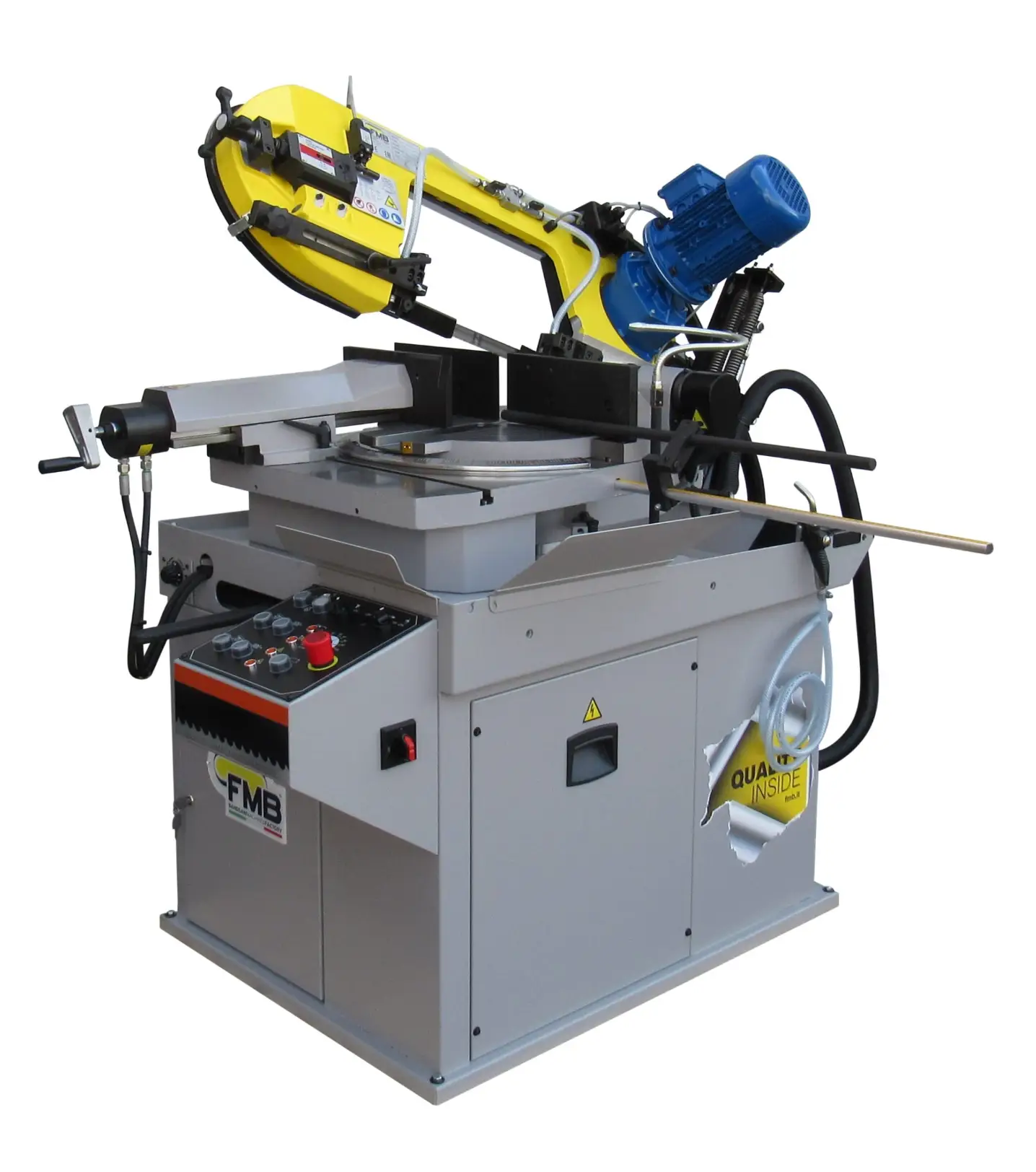
Angled metal cutting requires careful control of both workpiece positioning and blade advancement, particularly when producing opposing miters on structural sections. The FMB Omega bandsaw integrates double-miter capability with semi-automatic hydraulic saw-head operation, allowing operators to establish cutting angles while the machine controls the cutting stroke. Designed for fabrication environments handling varying material geometries, the Omega supports precise cutoff preparation without requiring fully automatic stock feeding or indexing.
Omega Features:
The Omega uses hydraulic saw-head feed to regulate blade advancement through the material during the cutting stroke. On mitered cuts, the blade encounters a changing cross section as it moves through the workpiece, making controlled feed particularly important. As a hydraulic miter bandsaw, the Omega provides a regulated cutting process for both square and angled operations, reducing the need for continuous manual control of saw-head movement.
The FMB Omega bandsaw provides double-miter capability for producing angled cuts in either direction. This configuration allows operators to change the cutting angle at the saw rather than turning long workpieces to achieve opposite-facing miters. For fabrication departments processing tubing, channels, and structural sections, bidirectional mitering can simplify material preparation for components requiring multiple angular geometries.
As a semi automatic double miter saw, the Omega supports applications where material dimensions, cutting angles, and production quantities change throughout the day. Operators retain control over material positioning and setup while the machine manages the cutting stroke. This arrangement provides a practical balance between controlled cutting performance and the setup flexibility required for short production runs, welded assemblies, and industrial fabrication work.

| Cutting Capacity | 0° | 45° Right | 60° Right | 45° Left | Bundle |
| Round | 9-1/2 in | 6-7/8 in | 4-1/3 in | 6 in | — |
| Rectangle A | 8 x 12-1/4 in | 6-5/8 x 6-5/8 in | 5-1/2 x 4 in | 5 x 5-5/8 in | 4-3/4 x 11 in |
| Rectangle B | 9-1/2 x 10-5/8 in | 9-3/8 x 6 in | — | 9-3/8 x 2-1/2 in | — |
| Square | 9-1/2 x 9-1/2 in | 6-5/8 x 6-5/8 in | 4 x 4 in | 5-1/3 x 5-1/3 in | — |
| Blade Size | 8 ft 10 in x 1 in x .035 in |
| Blade Speed | 52–394 FPM |
| Saw Motor Power | 2 HP |
| Voltages | 220V/3PH, 440V/3PH, 220V/1PH |
| Footprint | 35 x 59 in |
| Weight | 1,080 lbs |
The Omega addresses double-miter production through 60 degrees right and 45 degrees left as a semi-automatic miter bandsaw for production fabrication. Machine selection centers on whether its work envelope and operating method match the recurring part family.
The FMB Omega combines semi-automatic head and clamping functions with 9.5-inch round capacity, 60-degree right and 45-degree left mitering, and variable speed from 52 to 394 FPM. The correct configuration is determined by the full part range: material, oriented cross-section, length, angle or feature access, tolerance, batch size, tooling, coolant, and handling requirements.
The machine is commonly considered for:
The FMB Omega combines semi-automatic head and clamping functions with 9.5-inch round capacity, 60-degree right and 45-degree left mitering, and variable speed from 52 to 394 FPM.
The usable work envelope changes with head angle and material orientation, so the required cut must be checked against the capacity chart.
Blade tooth selection, speed, and downfeed are established from material grade, wall thickness, and tooth engagement.
Vise contact and correctly positioned infeed and outfeed supports keep the stock aligned through the blade path.
The hydraulic head and clamping system perform the cut and return after the stock and angle are set.
Yes. The published rectangular bundle capacity is 4.75 × 11 inches.
At 45 degrees left, it lists 6-inch round capacity and 5.33-inch square capacity.
The vise can be moved out of the standard position to accommodate special fixtures and nonstandard profiles.
Omega is better suited to recurring work where powered clamping and semi-automatic cycling offset the added machine complexity.