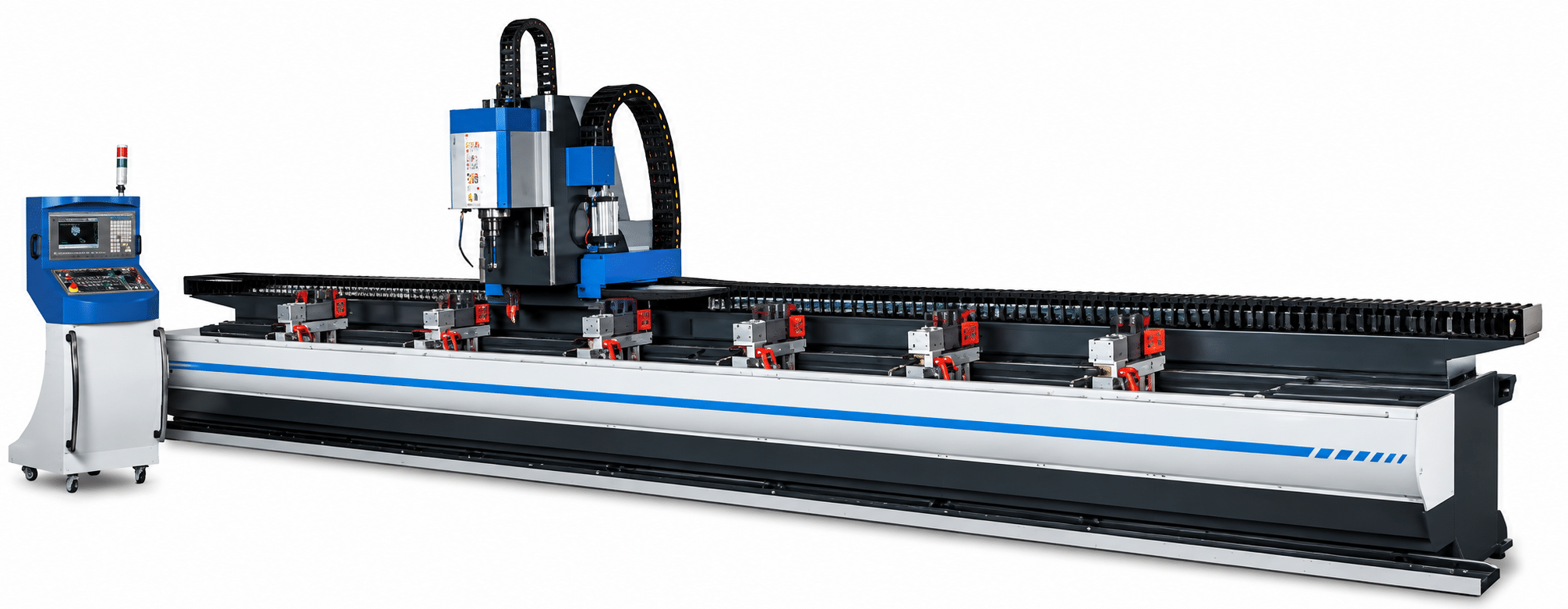
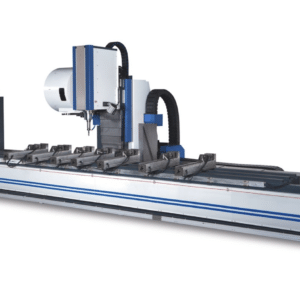
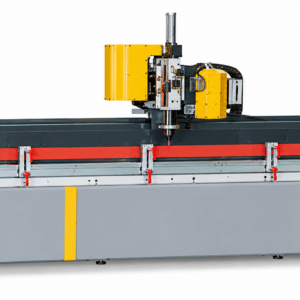
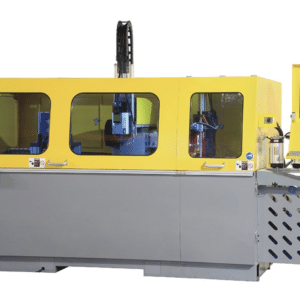
Long extrusion machining does not have to leave the spindle waiting while the next part is loaded. The PMI-CNC E-Type 3-Axis Profile Machining Center uses an extended work area that can operate as separate machining zones, allowing production to be organized around both part length and workflow. Manufacturers can machine long aluminum profiles across the available bed or use the divided work areas to prepare another component while machining continues, making the E-Type particularly relevant to repeat profile production where spindle utilization matters.
PMI-CNC E-Type 3-Axis Profile Machining Center Features:
The Pat Mooney E-Type is a dual-zone aluminum extrusion machining center designed to make better use of an extended working area. Depending on the job, the available bed can accommodate long components or be organized into separate work zones. This gives manufacturers more flexibility when production shifts between extended extrusions and batches of shorter profile components.
Long extrusion CNC machining allows drilling, milling, slotting, pocketing, and other secondary features to be positioned along an extended workpiece from a programmed setup. Rather than moving a long profile through several fixtures to reach different feature locations, the E-Type uses CNC axis travel to bring the machining process to the required positions along the component.
Configured as a pendulum profile machining center, the E-Type can use separate work areas to support loading and machining activity more efficiently. While machining takes place in one zone, the other can be used to prepare the next profile when the application and setup permit. This approach targets spindle utilization rather than simply increasing axis speed, making it valuable for recurring extrusion work where loading time represents a meaningful portion of the production cycle.
| Specification | Value |
| X-Axis Working Lengths | 11.5–24.6 ft (3.5–7.5 m) |
| Y-Axis Travel | 11.81 in (300 mm) |
| Z-Axis Travel | 7.87 in (200 mm) |
| Spindle | 18,000 RPM / 10 HP |
| Tool Holder | ISO 30 |
| Automatic Tool Changer | 8 tools |
| Processing | Dual zone |
| Controlled Axes | 3 |
The PMI-CNC E-Type 3-Axis Profile Machining Center addresses long aluminum extrusions with recurring hole patterns as a three-axis CNC profile machining center for aluminum and non-ferrous components. Machine selection centers on whether its work envelope and operating method match the recurring part family.
The E-Type uses three controlled axes for milling, drilling, and tapping aluminum and other non-ferrous profiles. Its layout is intended for long components that require repeatable features from programmed datums. The correct configuration is determined by the full part range: material, oriented cross-section, length, angle or feature access, tolerance, batch size, tooling, coolant, and handling requirements.
The machine is commonly considered for:
The E-Type uses three controlled axes for milling, drilling, and tapping aluminum and other non-ferrous profiles. Its layout is intended for long components that require repeatable features from programmed datums.
The PMI-CNC E-Type 3-Axis Profile Machining Center locates programmed features from a defined work offset rather than manual layout marks.
Workholding positions must secure the profile while leaving every required spindle or drill approach clear.
Programs retain the coordinates and process sequence for established part families.
It is a three-axis platform for programmed milling, drilling, and tapping of aluminum and non-ferrous profiles.
Feature access depends on the profile orientation and spindle approach; faces outside the three-axis access range require repositioning or a higher-axis configuration.
Profile shape, clamp contact, feature locations, tool clearance, wall thickness, and part length determine clamp placement.
Stored CNC programs retain coordinates, tools, speeds, feeds, and work offsets for established profile families.
The four-axis model becomes relevant when rotary positioning is needed to reach features around multiple faces of the profile.