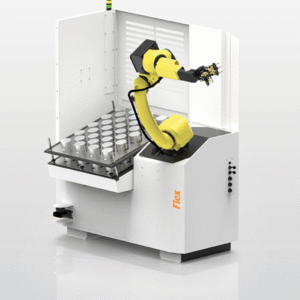

The Agile Flex 35P CNC Machine Tool Loading System is a cost-effective automation solution engineered for handling heavier workpieces and supporting larger CNC machines. Its robust structural design accommodates increased part weights while maintaining stable, repeatable loading performance. As a result, manufacturers can automate high-mass components without investing in overly complex systems. Designed for durability and efficiency, the Agile Flex 35P enhances machine utilization and extends unattended production capability in demanding machining environments.
The Agile Flex 35P is a fully integrated CNC pallet loader engineered to increase spindle utilization and reduce manual labor in precision manufacturing environments. Designed for seamless machine tool automation, it combines efficient part handling with fast pallet changeovers using a robust Fanuc robot loader. As a result, facilities benefit from higher throughput, improved scheduling, and reduced operator intervention.
At the core of the Flex 35P is an industrial-grade robot loader, equipped with dual grippers for efficient pallet handling. This robotic machine loading system ensures repeatable, accurate placement while eliminating manual loading variability. According to Agile Robotics, the unit offers plug-and-play CNC integration and requires no robot programming. Operators can quickly deploy the system across existing machine tools with minimal disruption.
The automated pallet system within the Agile Flex 35P supports high-mix, low-volume, and batch manufacturing with ease. Each pallet accommodates a broad range of part sizes, including complex or heavy components. This high-capacity pallet loader allows uninterrupted machining during changeovers and off-shift hours. Its modular design also enables future pallet expansions, aligning with growth in production demands.
Despite its compact footprint, the Flex 35P delivers scalable automation without compromising floor space. As a CNC pallet loader optimized for lean manufacturing, it integrates easily into new or existing cells. Additionally, the system’s automated pallet system improves workflow efficiency while maintaining high accuracy and uptime.
The Agile Flex 35P delivers a proven combination of Fanuc robot loader, robotic machine loading, and modular machine tool automation. Its reliability, ease of integration, and long-term scalability make it an ideal solution for precision manufacturers seeking a hands-free, high-performance system. When uptime and repeatability are critical, this high-capacity pallet loader delivers measurable ROI.
General
| Agile control software | Standard |
| Included standard nest plates (double layer) | 1 |
| Additional nest plates | Option |
| Power supply (KVA) | 3 |
| Pneumatic pressure (bar) | 6 |
Robot
| Fanuc M20 iA35M robot (35kg payload) | Standard |
| Double 3-jaw gripper | Standard |
| Gripper pressure control | Standard |
Capacities
| Workpiece diameter (min/max) | 1″ – 6″ / 25mm – 150mm |
| Workpiece length | >12″ />300mm (application dependant) |
| Workpiece weight – double gripping (max) | 17.5lbs / 8kg |
| Weight capacity (max) | 500 lbs / 250kg |
| Standard nest plate capacity $0.75″ – 04″ / ø20mm – Ø100mm (pieces) | 32 |
| Standard nest plate capacity 0.75″ – 2.5″ / Ø20mm – Ø63mm (pieces) | 72 |
| Standard nest plate capacity 0.75″ – 01.375″ / Ø20mm – Ø35mm (pieces) | 179 |
Safety
| Floor scanner | Standard |
| Integrated enclosure | Standard |
| Safety fence | Option |
The Agile Flex 35P is an pallet-based robotic loading system for larger CNC-machined parts. It is configured to move raw and completed workpieces between organized storage and the CNC machine while machinists remain available for setup, process control, inspection, and other skilled work. A.W. Miller Technical Sales supplies and supports Agile robotic machine-loading systems throughout New York, Pennsylvania, Maryland, Delaware, Southern New Jersey, and Quebec, with application review, cell integration, installation, training, and regional service.
The 35P uses a FANUC M-20iD/35 robot with a 35 kg payload and a standard double three-jaw gripper. Published capacity covers 1- to 6-inch workpiece diameters, double-gripped parts up to 17.5 lbs, and a pallet load up to 500 lbs. Final system capacity must be confirmed with the complete part, gripper, robot reach, storage arrangement, machine interface, safety layout, cycle-time target, and unattended production plan.
Applications commonly evaluated for the Agile Flex 35P include:
Nest plates arrange raw and finished parts on a pallet rather than dividing them among drawers. This format provides straightforward access and can accommodate parts longer than standard drawer storage.
Published nest layouts range from dozens to more than 200 positions depending on diameter. Actual quantity depends on part length, jaw clearance, spacing, and whether raw and completed parts share the same pallet.
The robot and double three-jaw gripper support larger components and efficient part exchange. Payload calculations must include both parts, jaws, adapters, and the gripper body.
A prepared nest plate and saved process parameters can shorten conversion between recurring jobs. CNC tooling, chuck jaws, programs, and inspection requirements must change with the automation setup.
The main differences are robot class, part size and weight range, and whether parts are staged on pallets, in drawers, in zero-point vises, or in shaft nests. The correct model follows the workpiece and production flow, not storage capacity alone.
Diameter, length, nest pitch, pickup clearance, raw and finished allocation, and the number of storage layers determine usable quantity. Published maximum counts apply only to the corresponding nest and part assumptions.
It can increase available spindle hours when manual loading is the limiting factor. Output still depends on a stable machining process, sufficient tool life, reliable workholding, controlled chips, consistent raw stock, and a schedule that keeps the cell supplied.
Gripper selection depends on part geometry, surface condition, weight, exchange method, and whether raw and finished parts must be held simultaneously. Jaw sensing, pressure control, and drop prevention should be matched to the risk of the application.
Stable, repeatable cycles with predictable part presentation are the strongest candidates. Turning, milling, multi-tasking, and grinding cells can all be evaluated when the robot can access the workholding and the process can run reliably without constant manual correction.