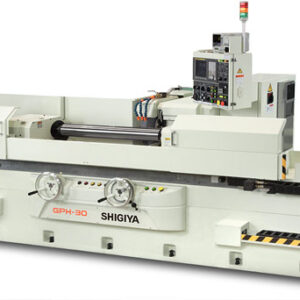
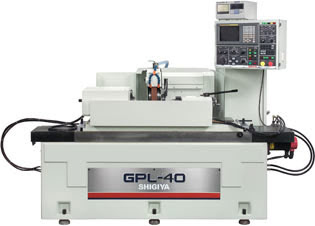
The Shigiya GPL-40B is a high-capacity production cylindrical grinder built for precision grinding of larger workpieces. It delivers stable, repeatable accuracy through a rigid machine structure, consistent thermal performance, and smooth grinding motion during extended production runs. As a result, the GPL-40B supports dependable throughput while maintaining tight tolerances and consistent part quality in demanding production environments.
The GPL-40B is a powerful CNC cylindrical grinder designed to meet the challenges of medium-to-heavy-duty grinding environments. Its stable platform, high-torque spindle, and precision slide systems ensure consistent performance across a wide range of applications. Because of its robust structure and flexible programming, this CNC cylindrical grinder is ideal for manufacturers needing precise control over roundness, finish, and dimensional accuracy. It supports both short-run and continuous production with ease.
As a high-precision grinding machine, the GPL-40B delivers precise results across long production cycles. Its rigid construction minimizes vibration, while its thermal stability maintains dimensional consistency. Moreover, this high-precision grinding machine handles a variety of materials, including hardened steel and high-alloy components. Its accuracy and repeatability allow manufacturers to meet strict part requirements while improving overall production.
The GPL-40B also functions as a versatile CNC grinder capable of adapting to a range of part profiles. Whether grinding cylindrical shafts, gear blanks, or large bushings, it offers easy tooling changes and flexible CNC control. Due to its responsive interface, this versatile CNC grinder supports rapid setup, efficient changeovers, and high-mix production. As a result, it allows manufacturers to stay agile while maintaining quality.
The GPL-40B excels in heavy-duty grinding solutions, delivering power and precision under load. It maintains grinding force and accuracy even on larger components or during extended shifts. These heavy-duty grinding solutions reduce downtime and extend wheel life, making the GPL-40B a valuable asset in industrial machining environments.
This machine also serves as intelligent precision machining equipment, ready to integrate into smart production lines. Its control system supports digital monitoring, adaptive feedback, and CNC logic-driven adjustment. In addition, the GPL-40B pairs seamlessly with automated grinding systems, including robotic loaders and material handling units. These automated grinding systems increase uptime, reduce labor, and support high-volume output with minimal operator input.
Metric
| Specifications | Units | |
|---|---|---|
| Swing Over Table | mm | 410 |
| Distance Between Centers | mm | 220, 470, 720, 970, 1470, 1970 |
| Weight Capacity | kg | 150 |
| Machine Weight | kg | 2900 / 3200 / 3900 / 4700 |
| Wheel Size OD | mm | 405 / 455 /510 |
| Wheel size width | mm | 100 |
| Wheel spindle | KW | 3.7 / 5.5/7.5 |
Standard
| Specifications | Units | |
|---|---|---|
| Swing Over Table | inch | 16.14 |
| Distance Between Centers | inch | 8.67 / 18.51 / 28.35/38.19 / 57.88 / 77.56 |
| Weight Capacity | lbs | 330.69 |
| Machine Weight | Ibs | 6393.41 / 7054.79 / 8598.03 / 10361.73 |
| Wheel Size OD | inch | 15.94 / 17.91 / 20.08 |
| Wheel size width | inch | 3.94 |
| Wheel spindle | HP | 4.96 / 7.38 / 10.06 |
The Shigiya GPL-40B is a long-workpiece CNC cylindrical grinder for shafts that require additional center distance while maintaining controlled OD geometry. A.W. Miller Technical Sales supplies and supports Shigiya grinding equipment throughout New York, Pennsylvania, Maryland, Delaware, Southern New Jersey, and Quebec, with application engineering, installation, training, and factory-certified service.
The 40-class GPL platform emphasizes work length and between-centers support. Published capacity varies by bed length, so maximum diameter, center distance, work mass, wheel size, and steady-rest locations must be confirmed together. Final machine selection should be based on the complete workpiece, stock allowance, tolerance, surface finish, wheel and dressing package, workholding, gauging, coolant system, automation target, and production rate.
Applications commonly evaluated for the Shigiya GPL-40B include:
The long-bed configuration accommodates shafts whose journal spacing exceeds standard grinder capacity while keeping the primary datums supported between centers.
Slender shafts may require one or more steady rests, balanced stock removal, and staged gauge checks to control bending through the grinding cycle.
Abrasive type, grade, bond, wheel dimensions, dress form, and dressing interval must be matched to material, stock allowance, finish, and cycle time. The GPL-40B process should be validated with the complete wheel and coolant package.
Centers or chucking, drive method, support, coolant filtration, temperature control, and gauge strategy determine whether the GPL-40B can hold the required size, roundness, cylindricity, and surface finish through production.
The 40-class GPL platform emphasizes work length and between-centers support. Published capacity varies by bed length, so maximum diameter, center distance, work mass, wheel size, and steady-rest locations must be confirmed together. The correct size is the smallest configuration that clears the complete part and workholding while meeting load, wheel, and process requirements.
Yes, when the wheel access, program, work support, and gauge plan allow it. Each diameter and shoulder must be checked for collision, stock condition, wheel form, dwell, traverse direction, and dressing demand.
Automation may include loading, chuck or center confirmation, in-process gauging, wheel dressing, part washing, and discharge. A stable manual process should be proven before unattended recovery logic is finalized.
Wheel specification and condition, dress parameters, work speed, traverse or plunge rate, spark-out, coolant delivery, vibration, and incoming stock all affect finish. A slower feed alone does not correct an unstable grinding system.
Flow, pressure, temperature stability, nozzle placement, filtration level, tank capacity, and material contamination must support both the wheel and tolerance. The coolant system should be treated as part of the machine process.