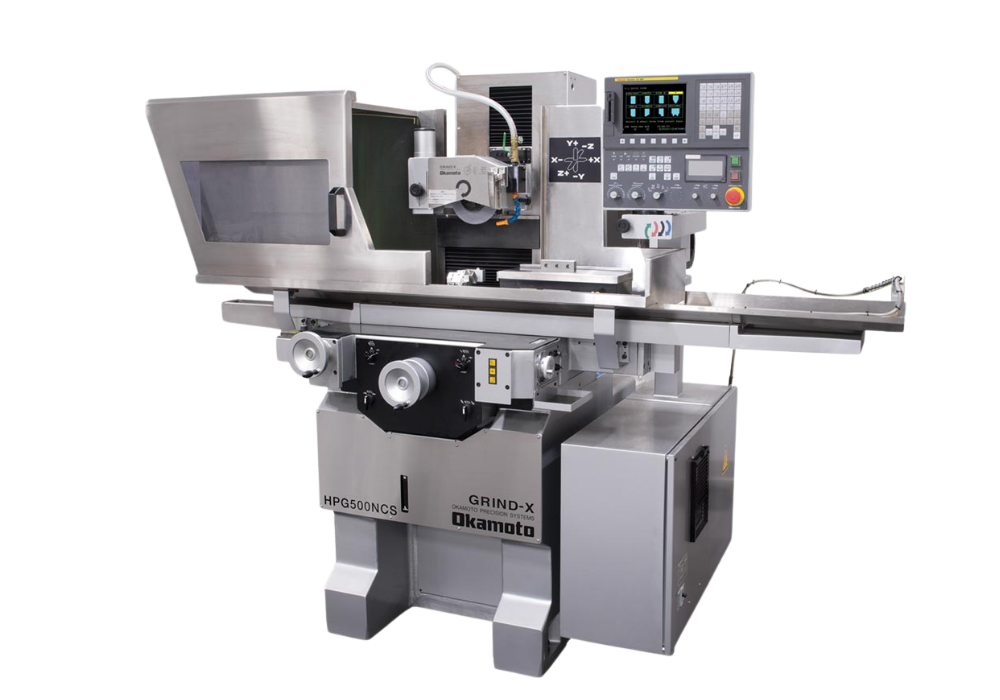
The Okamoto HPG-500NCS provides CNC-controlled surface and form grinding for small parts requiring tight tolerances and repeatable results. This high-speed Okamoto grinder combines precise axis positioning, short-stroke table performance, and programmable grinding cycles for demanding production environments.
HPG-500NCS Features:
| Max Cross Travel | 9" |
|---|---|
| Max Table Travel | 20.86" |
The Okamoto HPG-500NCS is a saddle type surface grinder built for small components with demanding dimensional and form requirements. It combines CNC control with high-speed table movement for precision surface and form grinding. The compact work area provides clear access for setup while supporting hardened steel, carbide, tooling, and mold applications. With repeatability down to 0.000004 inch, the HPG-500NCS provides the positioning control needed for tight-tolerance grinding.
Short grinding strokes can require fast, controlled table movement to maintain productive cycle times. The HPG-500NCS reaches up to 250 strokes per minute at a 0.5-inch stroke. In addition, double vee ways guide the longitudinal and crossfeed axes for consistent tracking during repeated cycles. It also features Servo-driven Y and Z axes for glass-scale feedback and precise positioning. Together, these features make this CNC saddle grinding solution effective for high-precision, short-stroke production applications.
A FANUC 0-iMF CNC with graphical conversational programming gives operators direct control over grinding and dressing cycles. The HPG-500NCS also incorporates a three-point dresser for flat and form dressing. This allows the grinding wheel profile to be maintained as part geometry and production requirements change. For manufacturers comparing Okamoto grinder technology, the HPG-500NCS combines CNC positioning, wheel management, and high-speed operation in one saddle-type platform.
| Max Cross Travel | 9" |
|---|---|
| Max Table Travel | 20.86" |
HPG-500NCS High Speed Form Grinder Specifications
The Okamoto HPG 500NCS is configured as a high-speed CNC form grinder, with its process strengths centered on high-precision form grinding for tooling and small mold components. The strongest applications are those where the machine configuration directly addresses a measurable constraint in accuracy, setup count, cycle consistency, or grinding access. A.W. Miller Technical Sales provides regional Okamoto support across New York, Pennsylvania, Maryland, Delaware, Southern New Jersey, and Quebec, from grinding-process evaluation and machine configuration through installation, training, and factory-certified service.
Before specifying the HPG 500NCS, manufacturers should document the incoming stock condition and the finished size, form, and surface requirements. Those inputs determine wheel selection, support strategy, dressing method, cycle structure, and whether optional process-control equipment is justified.
Parts and processes commonly evaluated for the Okamoto HPG 500NCS include:
The HPG 500NCS is aimed at applications where complex form accuracy and productive cycle time must be achieved together.
Programmable shift-plunge grinding supports repeated form locations and controlled stock removal.
Automatic overhead dressing and a table-mounted dresser provide options for maintaining wheel form through the process.
The machine is particularly relevant to smaller tooling and mold components where form definition is more important than a large work envelope.
It is a CNC form grinder intended for precision tooling, small mold inserts, and other components that require controlled wheel form and close dimensional accuracy.
The dressed wheel geometry becomes part of the finished feature. Dressing frequency, diamond condition, compensation, and coolant stability therefore need to be controlled with the grinding cycle.
It allows the wheel to grind defined positions or forms with programmable movement, which can improve consistency on repeated tooling features.
Okamoto lists Quick Touch as an optional manual touch-probe solution, allowing shops to evaluate an on-machine measurement strategy where appropriate.
The form geometry, tolerance, finish, material, heat treatment, stock allowance, wheel specification, dressing method, and inspection plan should be established first.