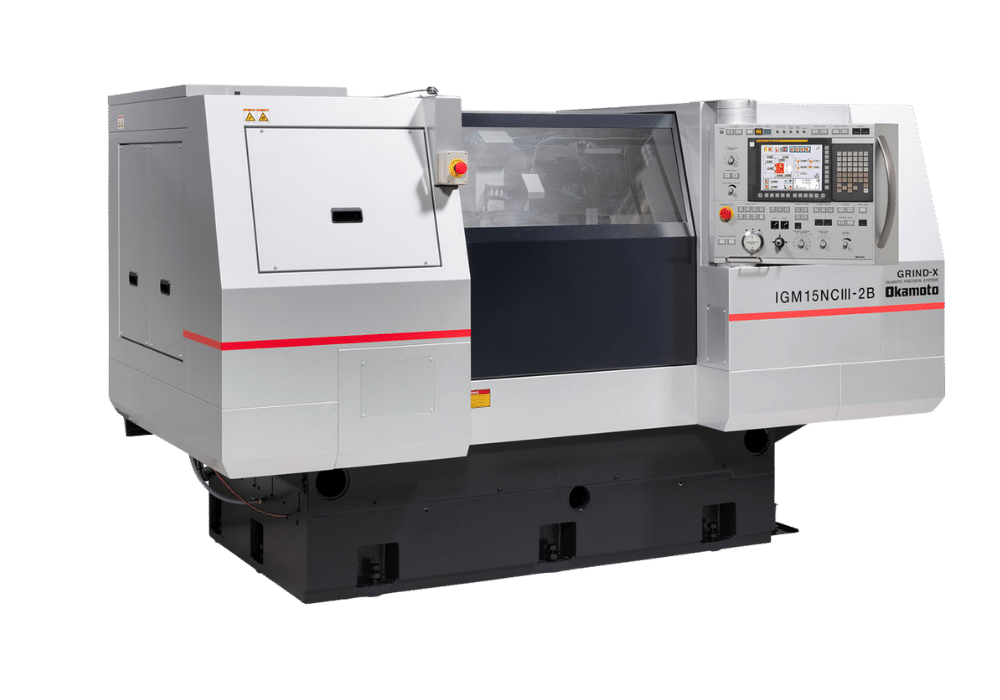
The Okamoto IGM 15NCIII/2B provides flexible grinding capability for precision components requiring multiple finished surfaces. Two independent grinding spindle systems support I.D., O.D., face, taper, and multi-step grinding in a single setup. Fine infeed control and programmable spindle speeds provide the process control required for close-tolerance bore and profile grinding.
IGM 15NCIII/2B Features:
| Internal Diameter | 6" |
|---|---|
| Max Table Travel | 20" |
The Okamoto IGM 15NCIII/2B uses two individual grinding spindles with independent slide systems to expand process flexibility. This configuration supports I.D., O.D., and face grinding within a single chucking. Manufacturers can produce straight bores, tapers, faces, and multi-step profiles while minimizing part repositioning. The twin spindle grinding machine is built for applications where multiple precision surfaces must maintain a consistent relationship to one another.
An AC-driven table provides minimum feed increments of 0.00001 inch for controlled positioning during demanding grinding cycles. Minimum diameter infeed increments also reach 0.00001 inch. Additionally, the wheelhead provides three programmable speeds to accommodate changing process requirements. A variable-speed workhead operates from 100 to 850 rpm, allowing operators to adjust grinding conditions for different workpiece materials, diameters, and geometries.
The IGM 15NCIII/2B combines automated grinding functions with controls developed to simplify machine setup and operation. Conversational input assists with programming, while an interrupt function allows wheel dressing during automatic grinding cycles. This CNC internal grinder can maintain wheel condition during production, supporting consistent dimensions and surface finishes across repeated parts.
| Internal Diameter | 6" |
|---|---|
| Max Table Travel | 20" |
IGM 15NCIII/2B Specifications:
The Okamoto IGM 15NCIII/2B is a twin-spindle internal grinding platform built around ID, OD, face, taper, and multi-step grinding in one chucking. Its value is determined by how well the grinding architecture matches the surfaces that control part function, including their size, form, finish, and relationship to adjacent features. A.W. Miller Technical Sales supports Okamoto grinding applications throughout New York, Pennsylvania, Maryland, Delaware, Southern New Jersey, and Quebec, providing applications engineering, installation, training, and factory-certified service.
For the IGM 15NCIII/2B, the part drawing should drive the process plan. Bore or surface geometry, tolerance, material condition, stock allowance, wheel specification, dressing frequency, coolant control, and gauging should be defined before the final machine configuration is selected.
Parts and processes commonly evaluated for the Okamoto IGM 15NCIII/2B include:
Two individual grinding spindles expand process flexibility when a part requires different wheel sizes or grinding conditions.
Grinding internal diameters, external diameters, and faces without reclamping helps protect concentricity and axial relationships.
AC-driven table motion and very fine programmable infeed support close-tolerance bore and profile work.
Automatic dressing and an interrupt function allow wheel condition to be managed during production rather than relying only on manual intervention.
Two spindles allow different wheel specifications or operations to remain available in the machine, reducing wheel changes when a component requires multiple grinding processes.
Yes. The platform supports ID, OD, face, straight, taper, and multi-step grinding, allowing related surfaces to be finished from one workholding when the part geometry permits.
Keeping ID, OD, and face features referenced to the same chucking reduces the datum transfer introduced by moving the part between separate machines or setups.
Bore diameter, bore depth, wheel diameter, required spindle speed, material, stock allowance, and finish requirement should be reviewed together before spindle selection.
No. Conversational programming and stored workpiece functions also support recurring and mixed production where setup control matters as much as cycle time.