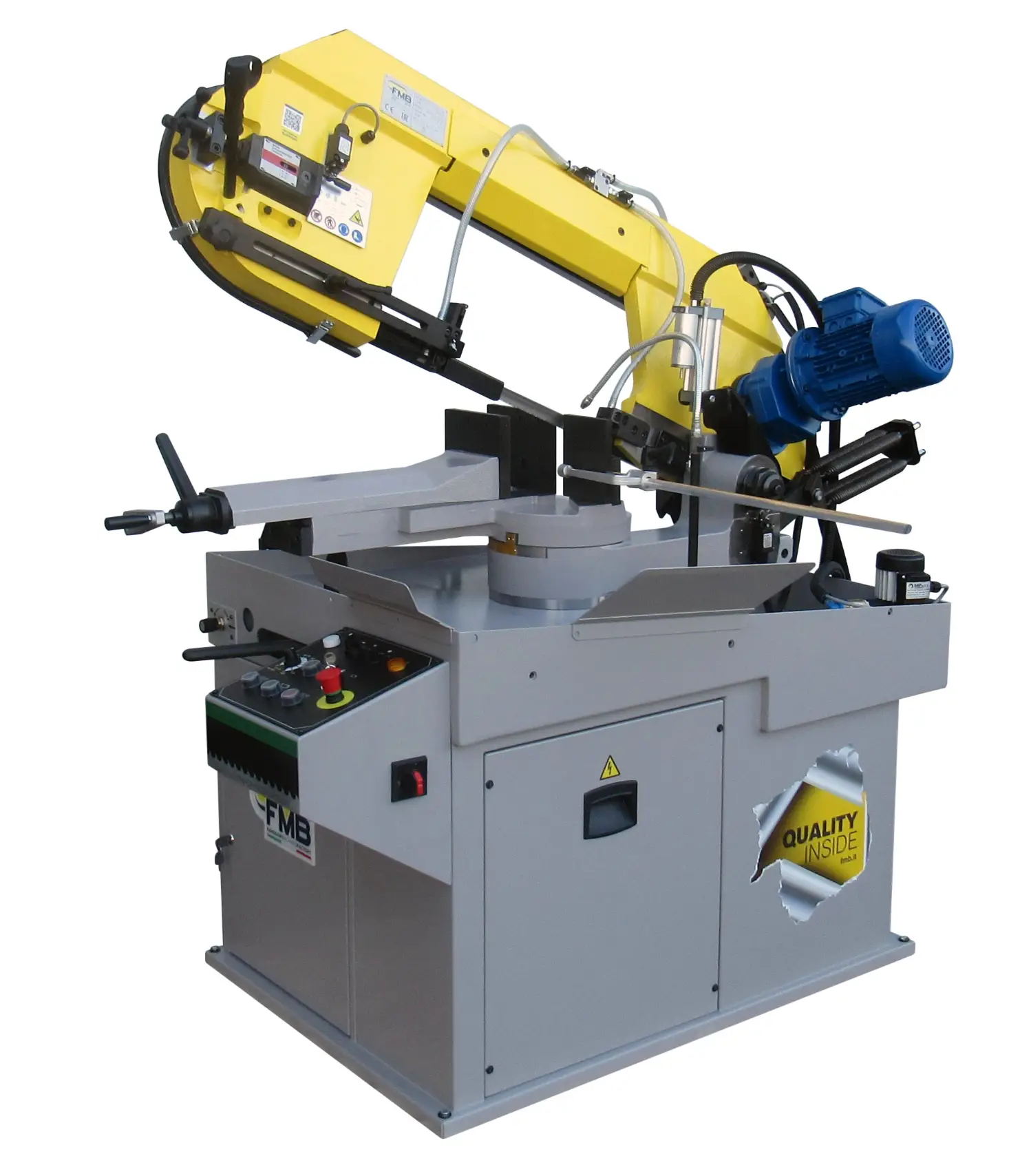
The FMB Mercury GV bandsaw is designed for cutting larger metal sections without the complexity of automated material indexing. With 12-inch round cutting capacity and gravity-controlled saw-head feed, the Mercury GV accommodates substantial bar stock, tubing, and structural profiles while maintaining operator control over material positioning and setup. Its combination of cutting capacity and adjustable downfeed makes it suitable for fabrication shops processing heavier sections in varying lengths and quantities.
Mercury GV Features:
The Mercury GV provides cutting capacity for round material up to 12 inches in diameter, expanding the range of stock that can be processed on a gravity-feed bandsaw. This capacity is particularly useful when working with larger solid bars, heavy-wall tubing, and structural components that exceed the cutting envelope of smaller fabrication saws. The FMB Mercury GV bandsaw gives manufacturers a dedicated solution for these larger cutoff requirements without moving to a fully automatic production system.
Rather than relying on powered hydraulic advancement, the 12 inch gravity feed saw uses controlled saw-head descent to move the blade through the workpiece. Adjustable downfeed allows the operator to regulate the cutting stroke according to the material being processed. This approach provides straightforward cutting control for applications where stock dimensions, cross sections, and production requirements vary between jobs.
Structural materials introduce different cutting conditions than solid round stock, particularly when the blade moves between thin walls, open sections, and changing material thicknesses. As a structural profile bandsaw, the Mercury GV accommodates tubing, channels, and other fabricated metal sections while allowing operators to establish appropriate cutting conditions for each workpiece. Its cutting envelope supports material preparation for welded assemblies, machine frames, supports, and general industrial fabrication.
| Cutting Capacity | 0° | 45° | 60° | Bundle |
| Round | 12 in | 10-1/4 in | 6-3/4 in | — |
| Rectangle A | 12 x 14-1/2 in | 6 x 10⁻¹/4 in | 6-1/4 x 6-3/4 in | 5-1/2 x 11 in |
| Rectangle B | — | 12 x 8-5/8 in | 10 x 6 in | — |
| Square | 12 x 12 in | 9-1/2 x 9-1/2 in | 6-1/4 x 6-1/4 in | — |
| Blade Size | 11 ft 3 in x 1 in x .035 in |
| Blade Speed | 52–394 FPM |
| Saw Motor Power | 2 HP |
| Voltages | 220V/3PH, 440V/3PH, 220V/1PH |
| Footprint | 43 x 67 in |
| Weight | 1,425 lbs |
For shops processing 12-inch round cutting, the Pat Mooney Mercury GV provides a variable-speed gravity-feed miter bandsaw for ferrous stock. The model should be evaluated as a complete cutting or machining process rather than by nominal capacity alone.
The FMB Mercury GV is a variable-speed gravity-feed miter bandsaw for bar, tube, and structural material. It provides 12-inch round capacity and right-hand mitering through 60 degrees. A complete application review includes stock geometry, material grade, required cut or feature locations, cycle volume, clamping surfaces, infeed support, and the method used to remove the finished part.
Applications commonly evaluated for this model include:
The FMB Mercury GV is a variable-speed gravity-feed miter bandsaw for bar, tube, and structural material. It provides 12-inch round capacity and right-hand mitering through 60 degrees.
The usable work envelope changes with head angle and material orientation, so the required cut must be checked against the capacity chart.
Blade tooth selection, speed, and downfeed are established from material grade, wall thickness, and tooth engagement.
Vise contact and correctly positioned infeed and outfeed supports keep the stock aligned through the blade path.
It provides gravity-feed cutting for larger 12-inch round stock without moving to a semi-automatic hydraulic cycle.
Yes. Its variable-speed drive lets the operator match tooth speed to tube, structural shapes, or solid bar.
The machine performs straight cuts and right-hand miters through 60 degrees.
The oriented height and width must fit the capacity at the selected angle, and the vise must contact the section without distortion.
The semi-automatic model is better when powered clamping, hydraulic head movement, and automatic return materially reduce cycle labor.