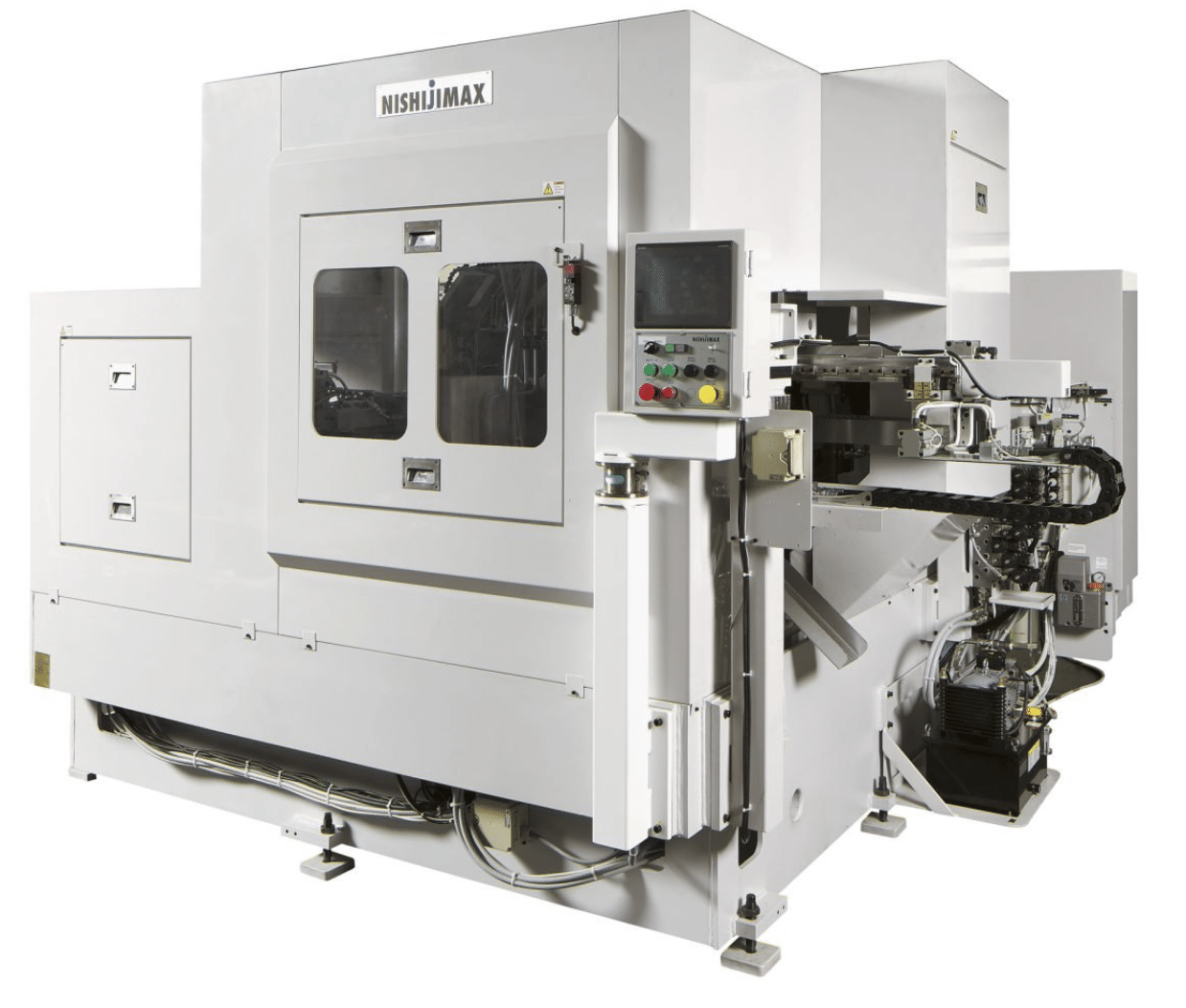
The NISHIJIMAX NHC-100M CNC Auto Miter brings programmable angle cutting to high-speed production sawing of steel bar and profiles. Its vertical-tilt saw head automatically positions for cuts from 45° left to 45° right, while a 21 HP blade drive and servo-controlled head feed support repeatable cutting across changing lengths and angles. With CNC control of blade RPM, chip load, and cut time, the NHC-100M is built to reduce manual setup while maintaining an efficient production cycle.
NHC-100M CNC Auto Miter Features:
The NHC-100M functions as a CNC steel miter saw for production work that requires more than straight 90° cutoff. Its vertical-tilt head can be programmed for angles anywhere between 45° left and 45° right while maintaining a maximum cutting range of 4 inches high by 4 inches wide. Automating the angle change reduces the manual setup normally required when a cut list includes multiple miter positions.
A precision ball screw and 10 HP AC servo motor control saw-head feed, while the 21 HP blade drive provides infinitely variable blade speeds from 32 to 115 RPM. The CNC uses programmed blade RPM and chip load per tooth to control cut time. This gives the vertical tilt circular saw a controlled cutting process for recurring production rather than relying on the operator to manually establish feed conditions for each cut.
Material utilization is especially important when an automatic angle cutting saw is processing long stock into multiple finished components. The NHC-100M uses a narrow 0.105-inch (2.5 mm) kerf to reduce material lost at each cutoff. Automatic cutting lengths range from 2¾ to 118 inches, with supply bar lengths from 12 to 24 feet, allowing programmed mitering and length control to work together in the production cycle.

| Specification | Value |
| Cutting Range | 4 in H x 4 in W max at 0° and 45° |
| Miter Range | 45° left to 45° right |
| Saw Blade Drive | 21 HP |
| Blade Speed | 32–115 RPM, infinitely variable |
| Saw Head Feed | 10 HP AC servo motor / precision ball screw |
| Kerf | 0.105 in (2.5 mm) |
| Cutting Length | 2-3/4 to 118 in automatic; 1 in minimum manual |
| Trim Cut | 1/2 to 4 in |
| Remnant Length | 2-3/4 in |
| Supply Bar Length | 12–24 ft |
| Machine Weight | 13,228 lb |
The Pat Mooney NHC-100M CNC Auto Miter is a fully automatic Nishijimax high-speed circular saw for straight and programmed miter cutoffs. Its configuration places the machine within a defined range of cutoff work rather than treating it as a general-purpose saw.
The vertical-tilt CNC saw head covers angles from 45 degrees left to 45 degrees right. Published specifications include a 4 × 4-inch maximum cutting range, 21-hp blade motor, 10-hp servo saw-head feed, 32–115 rpm blade speed, 2.75- to 118-inch automatic cut length, and 0.105-inch kerf. Final machine selection depends on the complete material range, section geometry, finished length, tolerance, production volume, blade requirements, clamping, material support, and part handling.
Common applications include:
The vertical-tilt saw head programs straight cuts and angles through 45 degrees in either direction.
A published 0.105-inch kerf limits material loss during recurring cut-to-length and miter work.
The CNC system coordinates material indexing, blade speed, chip load, and saw-head motion through the production cycle.
The 4 × 4-inch maximum range covers square and profile work requiring automatic angle changes.
The CNC vertical-tilt saw head positions from 45 degrees left through 45 degrees right, including straight 90-degree cutoffs.
Published capacity is 4 inches high by 4 inches wide at 0 degrees and throughout the specified left/right miter range. Minimum stock at 0 degrees is 0.75 × 0.75 inch.
The carbide circular blade produces a published 0.105-inch (2.5 mm) kerf. Material yield also depends on trim length, programmed part sequence, remnant length, and profile geometry.
Published automatic cutting length ranges from 2.75 to 118 inches. Manual mode permits a 1-inch minimum, while trim cuts range from 0.5 to 4 inches.
It fits part families requiring repeated left-hand, right-hand, and straight cuts within one automated program. A straight-cut model remains the simpler choice when angle changes are not part of the production mix.