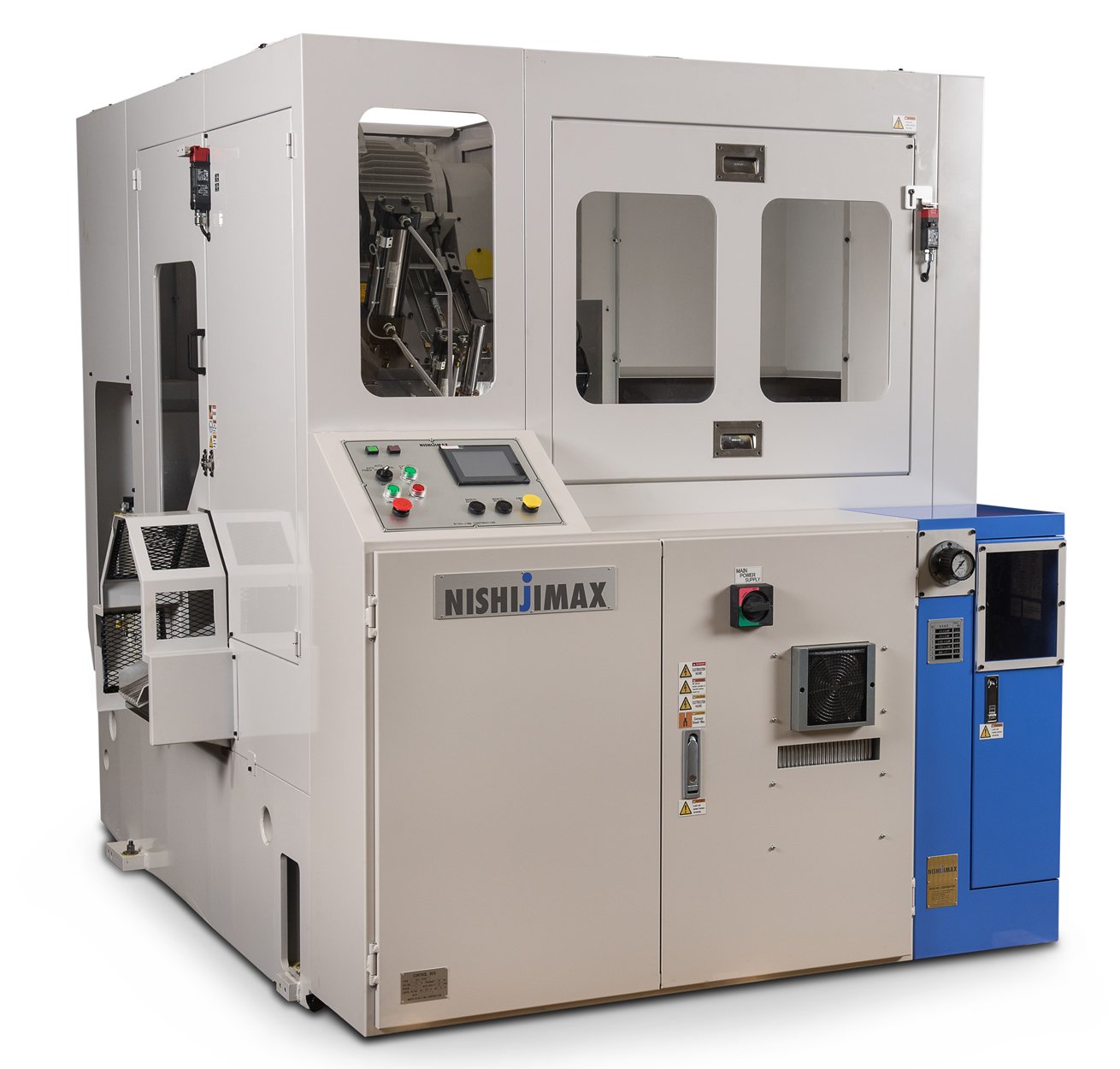
A 21 HP saw motor and 18-inch blade move the NISHIJIMAX NHC-160 into heavier ferrous production cutting. The machine handles round stock to 6.29 inches (160 mm) and square material to 4.3 inches, using a servo-driven 45° slant cutting axis and hydraulic clamping to control the work. For larger solid bar, forgings, and tube, the Pat Mooney NHC-160 adds the power and machine mass needed for sustained automatic cutoff work.
NHC-160 Series (6.29 inch Cutting Capacity) Features:
The Pat Mooney NHC-160 handles round material to 6.29 inches with a 21 HP motor and an 18-inch circular blade. That cutting package is suited to larger solid bars, forgings, tube, and similar ferrous stock where the cross section demands more spindle power and machine rigidity than a smaller cutoff saw can provide.
The saw head travels on a 45° slant axis driven by an AC servo motor and ball screw. Blade speed is adjustable from 32 to 115 RPM, allowing the cutting setup to be matched to the workpiece while the controlled feed manages how the blade enters and moves through the material.
A 19.68-inch single index positions stock for repeat lengths, and hydraulic horizontal and vertical clamping secures the material during the cycle. At approximately 15,000 pounds, the NHC-160 production circular saw provides a substantial base for automatic production cutting while material handling equipment can be added around the saw for longer bars and higher-volume workflows.

| Specification | Value |
| Cutting Capacity | 6.29 in (160 mm) round |
| Cutting Axis | 45° slant cutting axis |
| Saw Motor Power | 21 HP (15 kW) |
| Saw Blade RPM | 32–115 RPM |
| Saw Blade Diameter | 18 in (460/470 mm) |
| Single Index | 19.68 in (500 mm) |
| Machine Weight | 15,000 lb (6,500 kg) |
| Cutting Axis Drive | AC servo motor / ball screw |
| Sizer Axis Drive | AC servo motor / ball screw |
| Clamping | Hydraulic horizontal and vertical |
The Pat Mooney NHC-160 Series is a Nishijimax high-speed carbide circular saw for automatic production cutting of bar and tube up to the 6-inch class. Its configuration places the machine within a defined range of cutoff work rather than treating it as a general-purpose saw.
Published capacity ranges from 1 to 6.29 inches (25 to 160 mm) for round stock and 1 to 4.3 inches (25 to 110 mm) for square stock. The machine uses a 21-hp (15-kW) saw motor, a 32–115 rpm blade-speed range, an 18-inch-class (460/470 mm) blade, and an approximately 15,000-pound structure. Final saw selection depends on the complete stock range, material condition, cut length, tolerance, blade requirements, production rate, material handling, remnant strategy, and downstream process.
Manufacturers commonly evaluate this saw for:
The NHC-160 covers round stock to 160 mm and square stock to 110 mm for larger production part families.
An approximately 15,000-pound platform supports the spindle, guides, and clamps through demanding production cycles.
The servo cutting axis and variable blade range let the process be set around material, diameter, and carbide-tooth loading.
The Mitsubishi PLC and HMI support job setup, monitoring, troubleshooting, and planned communication with surrounding equipment.
Published capacity is 1 to 6.29 inches (25 to 160 mm) for round stock and 1 to 4.3 inches (25 to 110 mm) for square stock. Hollow sections, bundles, and difficult alloys require an application review.
Maximum round capacity increases from 5.118 to 6.29 inches, maximum square capacity increases from 3.54 to 4.3 inches, and the NHC-160 uses an 18-inch-class blade on an approximately 15,000-pound platform.
Hydraulic horizontal and vertical clamps secure the workpiece on both sides of the blade. Close six-point blade guides and the rigid slant-bed saw head further control the cutting zone.
Yes. Its PLC/HMI architecture and engineered load, exit, diverter, conveyor, and robotic-handling options support cell integration. Controls responsibility, part tracking, accumulation, and safety interfaces must be defined for the project.
The decision depends on the complete stock envelope, alloy and hardness, solid or hollow section, cut length and tolerance, parts per hour, blade strategy, bar presentation, remnants, finished-part handling, and available floor space.