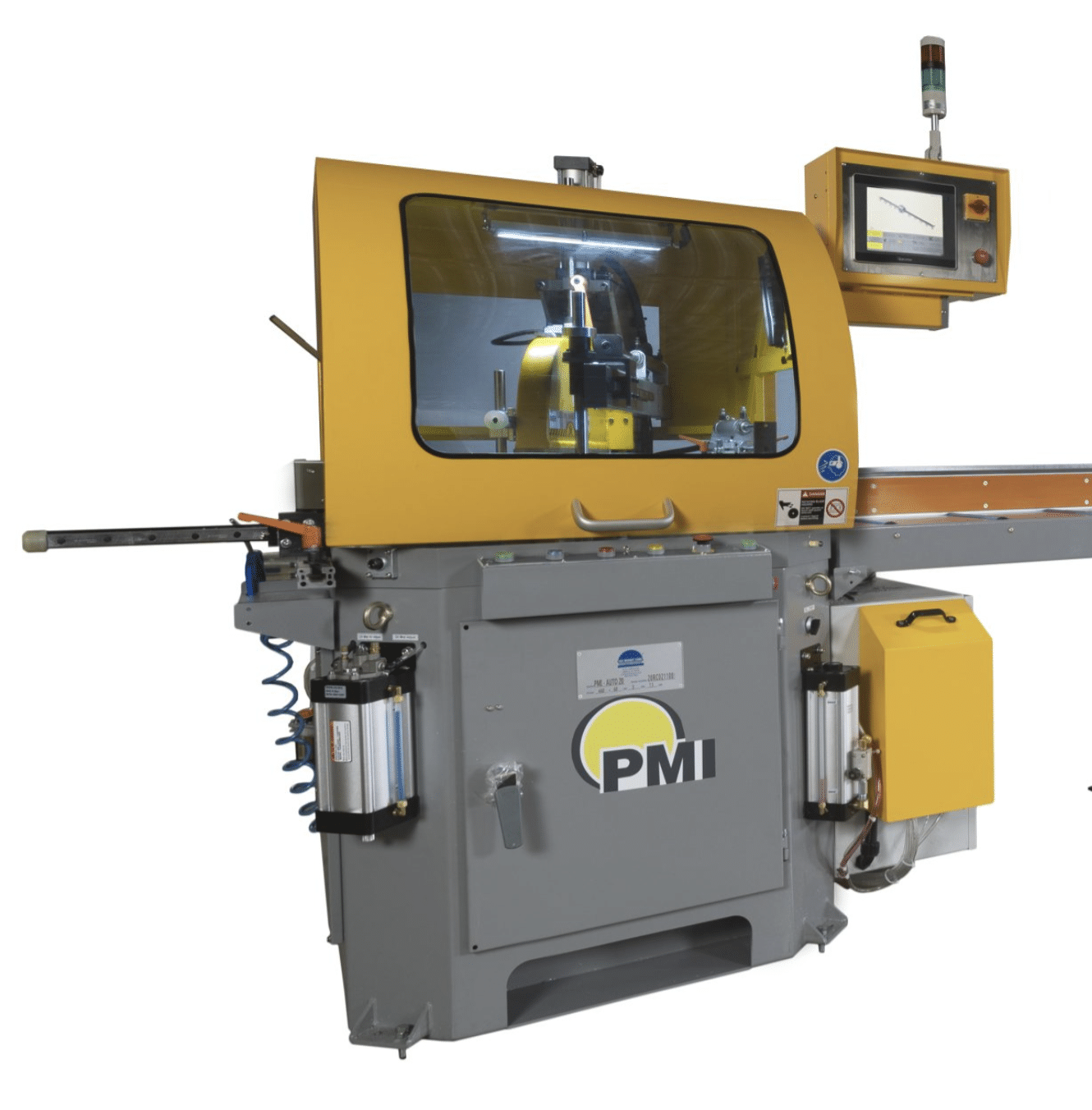
The PMI-20 CNC Auto Miter Upcut Saw is built around aluminum extrusion and profile work rather than ferrous bar cutoff. A 20-inch blade rises through the material at 3,000 RPM, while the powered saw head rotates 45° left or right and a servo-controlled pusher advances stock automatically. The combination gives window, curtainwall, transportation, fabrication, and extrusion operations a single machine for programmed length and miter production in aluminum and other nonferrous materials.
PMI-20 CNC Auto Miter Upcut Saw Features:
Between cuts, the blade remains below the work surface and enters the profile from underneath during the cycle. This arrangement allows the extrusion to be positioned and clamped before blade engagement, while keeping the cutting zone guarded below the table. For aluminum profiles with cosmetic surfaces or complex cross sections, controlled workholding is a central part of obtaining a clean cutoff.
The PMI-20 does more than automate stock advancement. Its saw head is servo powered through 45° left and right, and the built-in pusher uses servo control to position material for the next cut. These features make the machine useful for batches containing recurring mitered components because operators are not repeatedly measuring stock and manually resetting the head between parts.
The 7.5 HP motor drives the 20-inch blade at 3,000 RPM, a very different cutting regime from the low-RPM NHC ferrous saws. Published capacity reaches 5.9 inches high by 11 inches wide, and the feed rate is controlled through an air-over-oil system. Vertical and horizontal clamps with adjustable pressure help accommodate hollow extrusions and other profiles where excessive clamping force can be as problematic as insufficient restraint.

| Specification | Value |
| Saw Motor Power | 7.5 HP |
| Saw Blade Diameter | 20 in |
| Saw Blade Speed | 3,000 RPM |
| Maximum Cutting Capacity | 5.9 in height x 11 in width |
| Cut / Head Rotation | Servo-powered head, 45° left/right |
| Cutting Feed | Air-over-oil |
| Material Indexing | Servo-controlled automatic pusher |
The Pat Mooney PMI-20 CNC Auto Miter Upcut Saw is a fully automatic upcut saw for aluminum extrusion, profiles, and other non-ferrous materials. Its configuration places the machine within a defined range of cutoff work rather than treating it as a general-purpose saw.
A 20-inch blade and 7.5-hp motor provide a maximum cutting envelope of 5.9 inches high by 11 inches wide. The servo-powered saw head rotates 45 degrees left and right, while the built-in servo pusher, touchscreen, air-over-oil feed, and adjustable clamping manage automatic production. Final machine selection depends on the complete material range, section geometry, finished length, tolerance, production volume, blade requirements, clamping, material support, and part handling.
Common applications include:
The powered head rotates 45 degrees left and right for recurring angled and straight parts.
The built-in pusher indexes extrusion to the programmed length without a separate manual stop.
The 5.9 × 11-inch maximum envelope covers broad aluminum profile families.
Vertical and horizontal clamps with adjustable pressure secure thin-wall and complex profiles.
It is intended for aluminum extrusions and profiles, along with other non-ferrous materials such as copper, brass, and plastics when the blade and cutting parameters match the material.
Published maximum capacity is 5.9 inches high by 11 inches wide. The available envelope changes with the programmed miter angle and profile orientation.
A servo pusher positions the material, while the powered saw head rotates through 45 degrees left and right. Job data is entered through the touchscreen control.
The blade rises through the supported work zone while vertical and horizontal clamps hold the profile. This arrangement keeps the blade enclosed below the table between cuts and supports controlled profile cutting.
Profile height and width, angle, orientation, wall thickness, extrusion shape, finished length, tolerance, surface protection, clamping location, and part-support requirements determine the usable capacity.