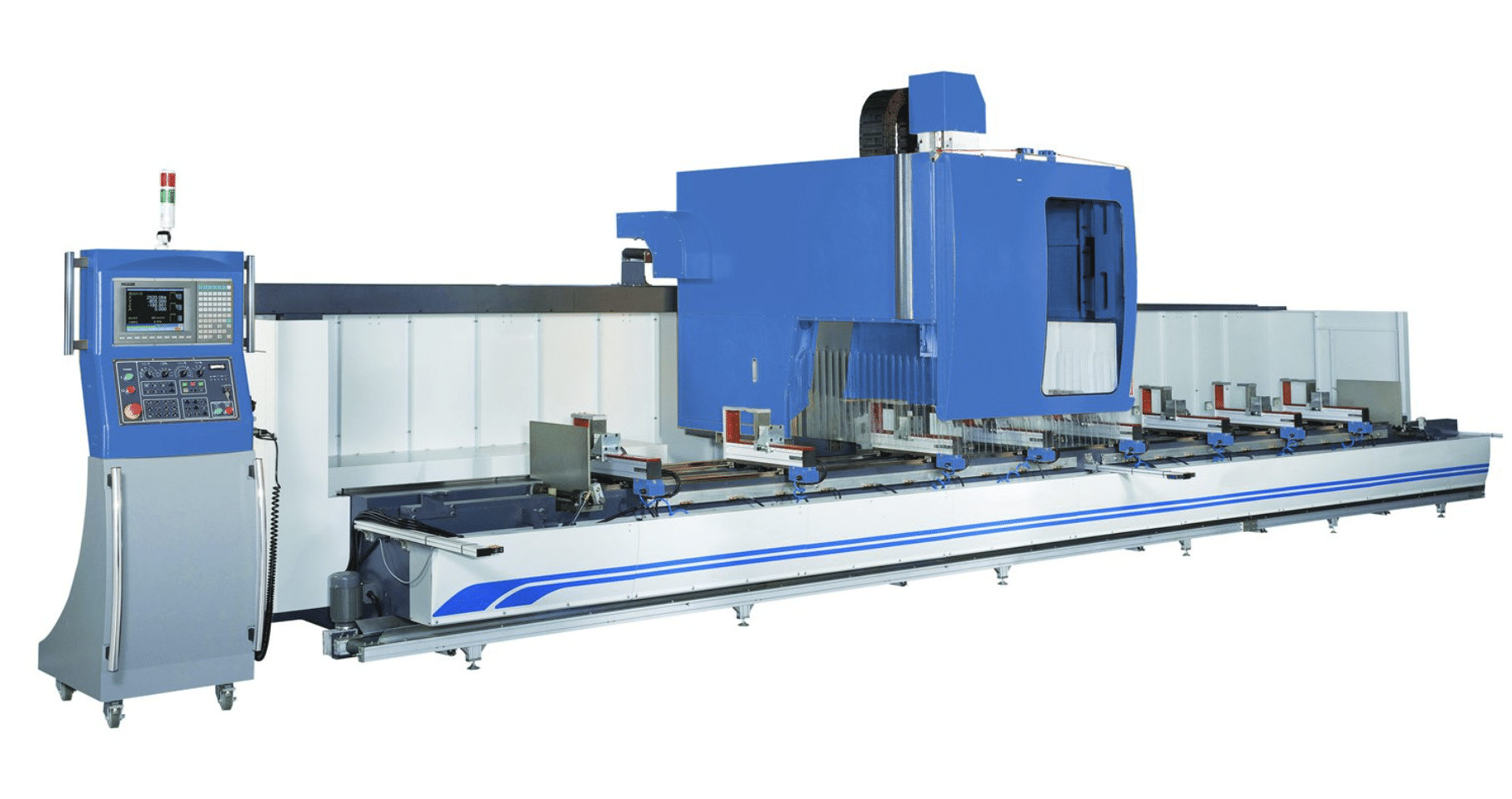
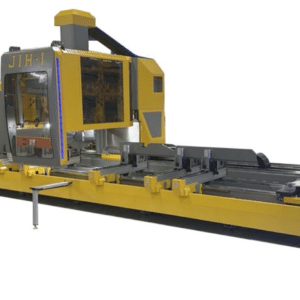
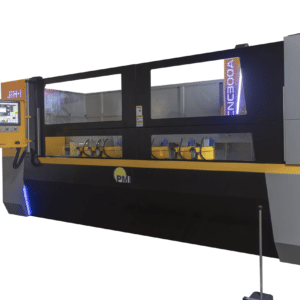
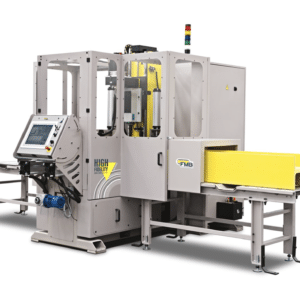
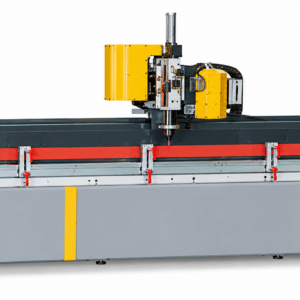
Machining features on the top and sides of an extrusion normally means additional setups when the spindle can only approach from one direction. The PMI-CNC S-Type 4-Axis Profile Machining Center addresses that limitation with a spindle that rotates to access multiple profile surfaces while the work remains clamped. CNC positioning coordinates drilling, milling, slotting, and other secondary operations along the extrusion, giving manufacturers a more efficient process for components with features distributed across several faces.
PMI-CNC S-Type 4-Axis Profile Machining Center Features:
The PMI-CNC S-Type is a 4-axis aluminum extrusion machining center developed for parts that require features on more than a single surface. Additional spindle positioning changes the tool approach without requiring the operator to remove and manually reorient the extrusion. This gives the machine greater access to profile geometry while preserving the relationship between features machined on different faces.
Multi-side CNC profile machining allows holes, slots, pockets, and milled details on different surfaces to be incorporated into the programmed sequence. The advantage becomes significant on recurring components where manually flipping or refixturing the profile would introduce another setup between operations. Keeping those features within one controlled process reduces handling while maintaining their programmed locations relative to one another.
Rotating spindle profile machining gives the S-Type its ability to address features that a conventional three-axis profile machine cannot reach from a fixed spindle orientation. Instead of moving the workpiece to present another surface to the tool, the spindle changes its approach to the extrusion. This capability is particularly valuable for complex fabricated profiles that require machining across several faces before moving to assembly or subsequent production operations.
| Specification | Value |
| X-Axis Working Lengths | 11.5–24.6 ft (3.5–7.5 m) |
| Y-Axis Travel | 15.75 in (400 mm); 8.66 in in 4-axis |
| Z-Axis Travel | 14 in (350 mm) |
| A-Axis | ±95° spindle rotation |
| Spindle | 18,000 RPM / 10 HP |
| Automatic Tool Changer | 12 tools |
| Processing | Dual zone |
| Controlled Axes | 4 |
For shops processing multi-face extrusion machining, the Pat Mooney PMI-CNC S-Type 4-Axis Profile Machining Center provides a four-axis CNC profile machining center for aluminum and non-ferrous components. The model should be evaluated as a complete cutting or machining process rather than by nominal capacity alone.
Four-axis control adds rotary positioning to linear machining of aluminum and non-ferrous profiles. This supports features on multiple faces without manually reorienting the workpiece between every operation. Capacity must be checked at the actual part orientation and cut angle, together with blade or tool selection, feed strategy, clamping, support length, and expected production rate.
Relevant production work includes:
Four-axis control adds rotary positioning to linear machining of aluminum and non-ferrous profiles. This supports features on multiple faces without manually reorienting the workpiece between every operation.
The PMI-CNC S-Type 4-Axis Profile Machining Center locates programmed features from a defined work offset rather than manual layout marks.
Workholding positions must secure the profile while leaving every required spindle or drill approach clear.
Programs retain the coordinates and process sequence for established part families.
Rotary positioning allows programmed access to additional faces of a profile without manually resetting its orientation.
Cross holes, slots, pockets, tapped holes, and features distributed around the profile can be programmed within the machine envelope.
No. Part length, clamp interference, feature location, and tool reach still determine whether a second setup is required.
The program must tie rotary position to a consistent part datum and verified clamp orientation.
Five-axis motion is more appropriate when compound-angle features require simultaneous or additional angular tool access.