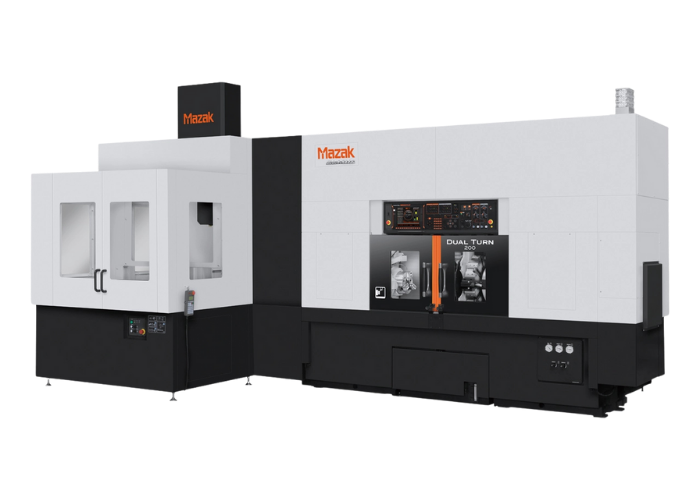
The Mazak Dual Turn 200 is a twin-spindle, twin-turret turning center designed for high productivity. With a mirror image design of headstocks and turrets plus automatic workpiece transfer from one spindle to the other, the machine enables continuous and simultaneous machining for completion of first and second operations in a single machine. Ideal for shops with limited floor space, the integration of two 2-axis turret lathes into a single machine tool is comparable to having two turning centers, but it requires approximately 30 percent less floor space.
Dual Turn 200 Features:
| Model | Dual Turn 200 |
|---|---|
| Chuck Size | |
| Max Workpiece Diameter | 12.6" |
| Max Machining Length | 5.91" |
The Mazak Dual Turn 200 is a compact yet powerful multi-tasking CNC machine designed for demanding production. Its dual-spindle, dual-turret layout enables true CNC multitasking, machining both ends of a part simultaneously. This design shortens cycle times, reduces handling, and improves part flow. From shafts to chucker-style parts, the Dual Turn 200 adapts to diverse production needs while maintaining consistent quality.
Equipped with Smooth CNC control, the Dual Turn 200 simplifies setup, reduces programming time, and supports real-time monitoring. MAZATROL conversational programming makes complex operations easier, while advanced motion coordination keeps both spindles synchronized during multi-surface cuts. The result is higher productivity, smoother operation, and less downtime.
Built with a rigid base and symmetrical design, the Dual Turn 200 ensures stable, high-precision CNC turning over long runs. By eliminating second setups, it improves part accuracy and reduces errors—critical for industries such as aerospace and automotive where tight tolerances are non-negotiable.
The Dual Turn 200 integrates easily with bar feeders, gantry loaders, and robotic arms for lights-out operation. As production demands grow, this multi-tasking CNC machine scales with job shops, delivering faster throughput and reliable precision across a wide range of applications.

| Model | Dual Turn 200 |
|---|---|
| Chuck Size | |
| Max Workpiece Diameter | 12.6" |
| Max Machining Length | 5.91" |
Dual Turn 200:
| Spindle | Chuck size | 8 “ |
|---|---|---|
| Max. spindle speed | 5000 rpm | |
| Spindle motor (40% ED) | 15 kW (20 HP) | |
| Spindle motor (cont. rating) | 11 kW (15 HP) | |
| Second spindle | Chuck size | 8 “ |
| Max. spindle speed | 5000 rpm | |
| Spindle motor (30 min. rating) | 15 kW (20 HP) | |
| Spindle motor (cont. rating) | 11 kW (15 HP) | |
| Turret | Tool storage capacity | 24 |
| Travel | X-axis | 9 “ |
| Z-axis | 20 “ | |
| Machine size | Width × Length (MAZATROL SmoothC) | 3420 ” × 1795 “ |
| Height | 2090 “ | |
| Machine weight | 6800 lbs |
The Mazak Dual Turn 200 combines first- and second-operation turning in one opposed-spindle platform. Parts transfer between operations without leaving the machine, reducing intermediate handling and separate-machine floor space. A.W. Miller provides regional applications engineering and factory-certified support from the initial process review through installation, training, and production. A.W. Miller Technical Sales is an authorized Mazak distributor serving manufacturers throughout New York, Pennsylvania, Maryland, Delaware, Southern New Jersey, and Quebec, with applications engineering, installation, training, and factory-certified service.
The Dual Turn 200 work zone and cutting package include two opposed turning spindles and coordinated part transfer for completing both ends of a component in one automated cycle. The final configuration should be checked against the part, fixture, tooling, spindle demand, and automation plan.
Typical process candidates for the Mazak Dual Turn 200 include:
One spindle performs the first operation, then the part transfers to the opposed spindle for machining of the remaining end.
Its production architecture is organized around opposed turning stations; the exact turret and spindle arrangement should be confirmed for the selected specification.
Shafts, fittings, hubs, connectors, and other parts requiring accurate work on both ends are primary candidates.
Combining first- and second-operation turning in one platform can replace separate machines and the buffer space between them.
One spindle performs the first operation, then the part transfers to the opposed spindle for machining of the remaining end.
Its production architecture is organized around opposed turning stations; the exact turret and spindle arrangement should be confirmed for the selected specification.
Shafts, fittings, hubs, connectors, and other parts requiring accurate work on both ends are primary candidates.
Combining first- and second-operation turning in one platform can replace separate machines and the buffer space between them.
Grip length, synchronization, cutoff condition, jaw geometry, part orientation, and transfer accuracy must be engineered as part of the cycle.