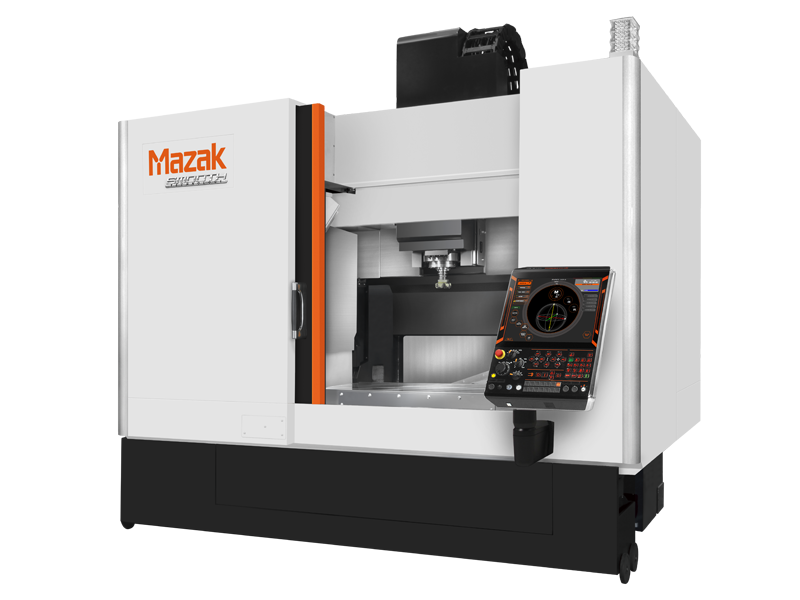
The FJV-250 is a robust Mazak vertical machine designed to deliver precision, reliability, and speed. Built on a rigid, compact frame, it offers exceptional stability while fitting seamlessly into tight shop spaces. Its design and intelligent technology make it ideal for manufacturers that need consistent quality and high throughput.
FJV 250 Features:
| Model | FJV-250 |
|---|---|
| Tool shank | 40 |
| Table size | 47.24" x 21.65" |
| Y Axis Stroke | 20.08" |
| X Axis Stroke | 40.16" |
| Z Axis Stroke | 18.11" |
$1.00
As part of Mazak’s advanced vertical CNC systems, the FJV-250 provides the perfect balance of precision and efficiency. Its rigid double-column construction minimizes vibration and ensures repeatability across long production runs. As a result, this machine is ideal for complex parts where dimensional accuracy and surface finish quality are critical.
The FJV-250 integrates high-speed machining solutions with Mazak’s SmoothG control and Ai Thermal Shield technology. The Ai Thermal Shield actively compensates for thermal displacement to maintain accuracy during temperature fluctuations. This combination shortens cycle times while ensuring consistent precision, allowing shops to maximize spindle utilization and hit production targets.
Engineered as a high-performance Mazak vertical machine, the FJV-250 supports automation-ready configurations for lights-out production. For example, it easily integrates with pallet changers, probing systems, and robotic loading systems. As a result, shops have the capability to scale output and reduce downtime. This flexibility makes it a dependable solution for industries like aerospace, automotive, and mold-making where speed and reliability are essential to remain competitive in the evolving markets.
| Model | FJV-250 |
|---|---|
| Tool shank | 40 |
| Table size | 47.24" x 21.65" |
| Y Axis Stroke | 20.08" |
| X Axis Stroke | 40.16" |
| Z Axis Stroke | 18.11" |
| Table | Table size | 47.24″ × 21.65″ |
|---|---|---|
| Distance between columns | 54.33″ | |
| Max. loading weight(equal distribution) | 2645 lbs | |
| Spindle | Tool shank | BT40 |
| Max. spindle speed | 12000 rpm | |
| Max. torque (40% ED) | 52.8 ft-lbs | |
| Max. torque (cont. rating) | 38.7 ft-lbs | |
| Spindle motor (40% ED) | 22 kW (30 HP) | |
| Spindle motor (cont. rating) | 15 kW (20 HP) | |
| Automatic tool changer | Tool storage capacity | 30 |
| Max. tool diameter | Φ3.15″ | |
| Max. tool diameter (without adjacent) | Φ4.92″ | |
| Max. tool length (from gauge line) | 11.81″ | |
| Max. tool weight | 17.64 lbs | |
| Travel | X-axis | 40.16″ |
| Y-axis | 20.08″ | |
| Z-axis | 18.11″ | |
| Distance from table top face to spindle end | 7.87″ to 25.98″ | |
| Rapid traverse rate | X-axis | 2047 IPM |
| Y-axis | 2047 IPM | |
| Z-axis | 2047 IPM | |
| Machine dimensions | Width x Length (MAZATROL SmoothG) | 118.9″ × 102.91″ |
| Height | 115.2″ | |
| Machine weight | 18739 lbs |
The Mazak FJV-250 is an extended double-column machining platform for oversized structural work. Long plates, machine bases, large dies, and heavy fabrications can remain supported while the bridge and spindle move through the machining envelope. A.W. Miller Technical Sales is an authorized Mazak distributor serving manufacturers throughout New York, Pennsylvania, Maryland, Delaware, Southern New Jersey, and Quebec, with applications engineering, installation, training, and factory-certified service.
Capacity for the FJV-250 includes an extended double-column table and travel package, 50-taper spindle capability, and high-load construction for oversized structural work. Table load, fixture support, tool reach, spindle demand, chip control, lifting access, and facility requirements should be confirmed against the complete process.
Typical production candidates include:
FJV-250 is selected for oversized plates, structures, bases, and dies that require an extended double-column work envelope.
The total part and fixture load must remain within table limits and be distributed to avoid local loading, distortion, and support problems.
The process is practical when travel, tool access, probing, chip management, loading, and safe separation support a multi-fixture strategy.
Large components amplify small alignment errors, so machine geometry, foundation, thermal conditions, and calibration directly affect feature relationships.
It is selected for oversized plates, structures, bases, and dies that require an extended double-column work envelope.
The total part and fixture load must remain within table limits and be distributed to avoid local loading, distortion, and support problems.
Yes, when travel, tool access, probing, chip management, loading, and safe separation support a multi-fixture strategy.
Large components amplify small alignment errors, so machine geometry, foundation, thermal conditions, and calibration directly affect feature relationships.
Foundation, floor loading, crane coverage, door and shipping access, utilities, chip removal, service space, and part staging must be verified.