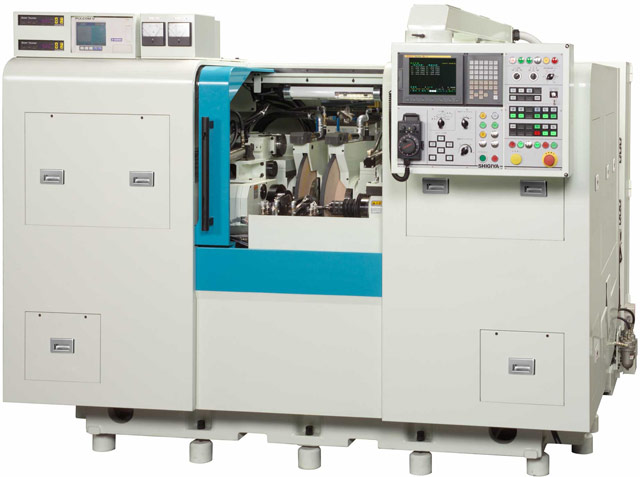
The Shigiya GNW-30 is a high-capacity non-round cylindrical grinder built for precision grinding of larger, more complex profiles. It delivers consistent, repeatable accuracy through a rigid machine structure, precise axis coordination, and stable thermal performance during extended production runs. As a result, the GNW-30 supports reliable production of non-cylindrical components while maintaining tight tolerances and consistent part quality.
The Shigiya GNW-30 is a 2-head CNC grinder designed to enhance productivity in manufacturing environments. Its double-head cylindrical grinder configuration allows for simultaneous two-diameter grinding, effectively reducing cycle times and improving throughput. With synchronized driving work heads, the GNW-30 ensures precise and consistent results across various workpieces. This compact CNC grinder is suitable for both small and large production runs, offering flexibility and efficiency in one machine.
Equipped with dual wheel heads, the GNW-30 performs simultaneous two-diameter grinding, allowing two different surfaces to be ground in a single setup. This capability significantly reduces the need for multiple machines or setups, streamlining the production process. The synchronized driving work heads maintain high part accuracy, ensuring that each component meets stringent quality standards. This feature is particularly beneficial for applications requiring tight tolerances and consistent finishes.
Despite its robust capabilities, the GNW-30 maintains a compact footprint, making it an ideal choice for facilities with limited space. Its design does not compromise on performance; the machine delivers high-precision grinding suitable for a variety of applications. The compact CNC grinder’s efficiency and precision make it a valuable asset in industries such as automotive, aerospace, and general manufacturing.
Metric
| Specifications | Units | |
|---|---|---|
| Swing Over Table | mm | 300 |
| Distance Between Centers | mm | 250, 400, 600 |
| Weight Capacity | kg | 150 |
| Machine Weight | kg | 7500 / 9000 / 11000 |
Standard
| Specifications | Units | |
|---|---|---|
| Swing Over Table | inch | 11.81 |
| Distance Between Centers | inch | 9.84 / 15.75 / 23.63 |
| Weight Capacity | lbs | 330.69 |
| Machine Weight | Ibs | 16534.67 / 19841.6 / 24250.85 |
The Shigiya GNW-30 is a two-wheelhead CNC cylindrical grinder for high-production grinding sequences that divide roughing, finishing, or different features between wheels. A.W. Miller Technical Sales supplies and supports Shigiya grinding equipment throughout New York, Pennsylvania, Maryland, Delaware, Southern New Jersey, and Quebec, with application engineering, installation, training, and factory-certified service.
The 30-class GNW platform uses multiple grinding stations to reduce non-cutting time and keep feature relationships within one machine cycle. Swing, center distance, wheel arrangement, and automation equipment vary with the application. Final machine selection should be based on the complete workpiece, stock allowance, tolerance, surface finish, wheel and dressing package, workholding, gauging, coolant system, automation target, and production rate.
Applications commonly evaluated for the Shigiya GNW-30 include:
Separate wheels can divide roughing and finishing or address different feature groups, reducing wheel changes and non-cutting movement.
Wheel assignments, dressing intervals, gauge checks, and loading time should be balanced so one station does not limit the production rate.
Abrasive type, grade, bond, wheel dimensions, dress form, and dressing interval must be matched to material, stock allowance, finish, and cycle time. The GNW-30 process should be validated with the complete wheel and coolant package.
Centers or chucking, drive method, support, coolant filtration, temperature control, and gauge strategy determine whether the GNW-30 can hold the required size, roundness, cylindricity, and surface finish through production.
GNW-30 is most valuable when its two-wheelhead cnc cylindrical grinder configuration directly addresses the part’s size, feature access, work support, or production sequence. Selection should be based on a documented process advantage rather than model familiarity.
Confirm which surfaces require straight, angular, internal, face, or specialty access; then check wheel diameter, width, swivel or approach, guard clearance, dressing location, and interference with workholding.
Yes, but hardened steel, stainless, carbide, coatings, and other materials can require different abrasives, bonds, speeds, coolant, filtration, dress tools, and stock allowances. Cross-contamination and changeover should also be considered.
Common contributors include thermal change, wheel wear, dress variation, part deflection, center condition, coolant temperature, gauge repeatability, stock variation, and inconsistent spark-out. Process data should identify the dominant source before compensation is changed.
Foundation, leveling, vibration from nearby equipment, ambient temperature, power, air, coolant system, mist collection, material handling, and maintenance access all affect long-term performance and should be reviewed before delivery.