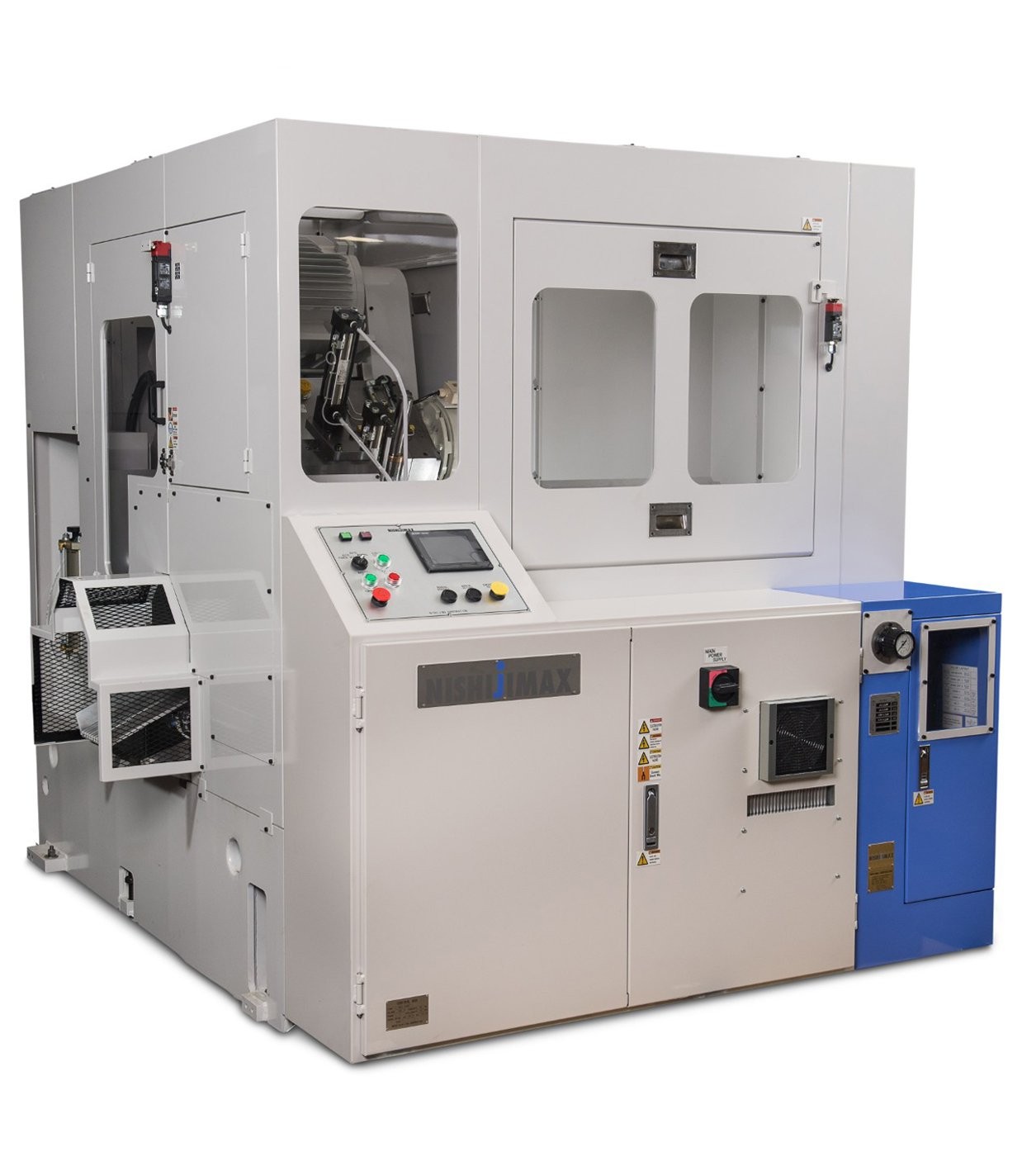
For steel bar, tube, and pipe that outgrow an 80 mm saw, the NISHIJIMAX NHC-110 provides 4.33-inch (110 mm) cutting capacity in an automatic high-speed circular saw. Servo-controlled cutting and material sizing work with hydraulic clamping to manage repeat cutoff cycles, while the Pat Mooney NHC blade-support and chip-control systems help maintain cutting consistency as production volume increases.
NHC-110 Series (4.33 inch Cutting Capacity) Features:
The NHC-110 is sized for recurring ferrous cutoff work up to 110 mm. That envelope covers a useful range of steel bar, tube, pipe, and component blanks while keeping the machine focused on production work that does not require the larger drives and blade packages used farther up the NHC line.
The cutting axis and material sizing axis are controlled separately with AC servo motors and ball screws. As a result, the NHC-110 production circular saw regulate blade movement through the stock while automatically positioning material for the programmed cut length, reducing manual measuring and stop adjustment during repeat jobs.
Hydraulic clamping secures the material through the cut, and precision blade guides support the circular blade close to the work. A powered brush removes chips from the teeth as the blade runs. Together, these Pat Mooney sawing systems address the stability and chip control needed for repeat cutting of ferrous tube, pipe, and solid stock.
| Specification | Value |
| Cutting Capacity | 4.33 in (110 mm) maximum |
| Cutting Axis Drive | AC servo motor / ball screw |
| Sizer Axis Drive | AC servo motor / ball screw |
| Clamping | Hydraulic horizontal and vertical |
The Pat Mooney NHC-110 Series is a Nishijimax high-speed carbide circular saw for automatic production cutting of mid-size bar and tube. Its configuration places the machine within a defined range of cutoff work rather than treating it as a general-purpose saw.
Published capacity ranges from 0.590 to 4.33 inches (15 to 110 mm) for round stock and 0.590 to 2.91 inches (15 to 75 mm) for square stock. The 45-degree slant cutting axis uses AC-servo and ball-screw feed, while a 21-hp (15-kW) saw motor supplies cutting power. Machine weight is approximately 11,700 pounds. Final saw selection depends on the complete stock range, material condition, cut length, tolerance, blade requirements, production rate, material handling, remnant strategy, and downstream process.
Manufacturers commonly evaluate this saw for:
The NHC-110 expands the working range to 110 mm round stock while retaining a production-focused carbide cutoff process.
The approximately 11,700-pound structure supports the spindle, guides, and clamps during recurring cuts in larger stock.
Servo-driven saw-head motion allows blade RPM and chip load per tooth to be set for the material and section being cut.
The servo-controlled X-axis sizer advances stock to the programmed cut length and retracts after each cycle.
The NHC-110 accepts round stock from 0.590 to 4.33 inches (15 to 110 mm) and square stock from 0.590 to 2.91 inches (15 to 75 mm). Application approval should also consider section shape, material grade, blade geometry, and workholding.
It covers round stock beyond the NHC-80’s 3.149-inch maximum without moving to the NHC-130’s 5.118-inch range. It is a practical selection when most production centers on bar up to 4.33 inches.
Close-positioned blade guides, clamping on both sides of the cut, a precision spindle and reduction gearbox, controlled chip load, and a powered chip brush all help protect the carbide teeth. Blade selection and material presentation remain essential.
The NHC platform uses a Mitsubishi PLC and HMI for job setup and machine monitoring. The control can communicate with other devices, but the required connection and data exchange should be defined during system engineering.
Review every stock diameter or section, alloy and hardness, incoming and finished lengths, cut tolerance, finish, kerf allowance, pieces per shift, bundle-loading method, remnant plan, and exit handling.