Ultra-High Precision Form Grinding
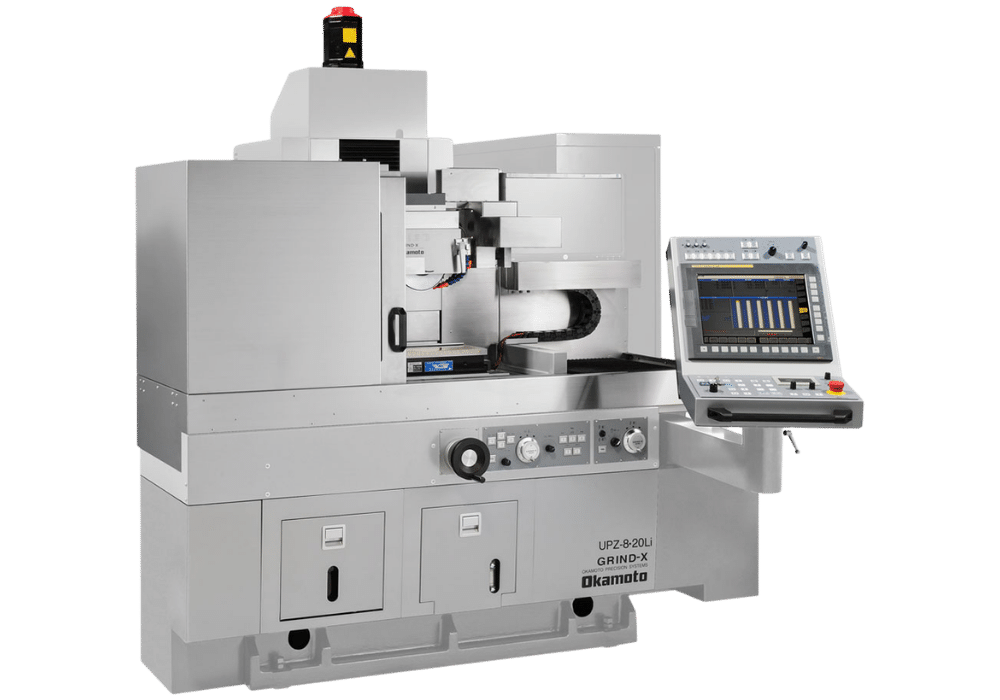
The Okamoto UPZ 820 Li is a precision form grinder built for complex components requiring tight tolerances and repeatable positioning. A rigid traveling-column design provides a stable foundation for demanding grinding applications. In addition, digital scale feedback on the vertical and cross axes supports precise positioning throughout the grinding cycle. This combination provides the control required for intricate geometries, fine surface finishes, and precision slit grinding.
Linear Motor Table for High-Speed Grinding
A linear motor drives the longitudinal table to provide high-speed stroke performance without sacrificing positioning stability. The drive system eliminates conventional table-drive components while supporting responsive motion during short-stroke and detailed grinding operations. Combined with digital scale feedback, the UPZ 820 Li supports high-speed surface grinding where dimensional accuracy and surface quality must remain consistent across repeated parts.
CNC Control for Complex and High-Mix Applications
The UPZ 820 Li supports multi-position grinding for manufacturers processing varied part geometries and small production quantities. A FANUC 0-iMF CNC provides simultaneous two-axis operation across three controlled axes. Automatic grinding, shift-plunge grinding, and dressing cycles further reduce manual intervention. In addition, a standard three-point dresser maintains wheel condition, while an optional rotary dresser expands capability for more complex grinding profiles.
Standard Accessories
- Grinding Wheel with Adaptor
- Frequency Inverter for Spindle Motor
- Chuck Controller
- CNC
- Touch Panel
- Automatic Grinding Cycle
- Shift-Plunge Grinding Cycle
- Automatic Dressing Cycle with Overhead Dresser
- Table Mount Dresser with Automatic Cycle
- Chuck Datum Cycle
- Splash Guard
- Installation
Optional Accessories
- Additional Grinding Wheel Adaptor
- Wheel Balancing Stand with Arbor
- Various Chucks
- Chuck Safety Interlock
- Various Coolant Systems
- Magnetic Separator
- Coolant Temperature Controller
- Overhead Dresser
- Manual Touch Probe Quick Touch
- Fully Enclosed Cover
- Door Interlock with Fully Enclosed Cover
- Hydraulic Oil Temperature Regulator
- Metric Conversion Kit

 This product has multiple variants. The options may be chosen on the product page
 This product has multiple variants. The options may be chosen on the product page
 This product has multiple variants. The options may be chosen on the product page
 This product has multiple variants. The options may be chosen on the product page